20342

- Inside eriac
- Highlights
- ROMAMOMA
- ERIACNET4EU
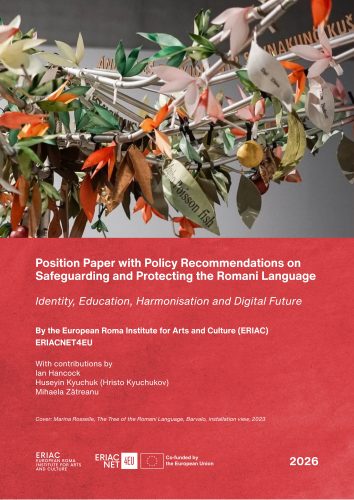
- 2026 | Position Paper: Safeguarding the Romani Language
- 2026 | FSTP Beneficiaries
- 2026 | Capacity-Building Trainings
- 2025 | Position Paper: Media Representation and Production
- 2025 | FSTP Beneficiaries
- 2025 | Capacity-Building Trainings
- 2024 | POSITION PAPER: REMEMBRANCE, COMMEMORATION AND HISTORY TEACHING
- 2024 | FSTP Beneficiaries
- 2024 | Capacity-Building Trainings
- 2023 | POSITION PAPER: EDUCATION AND KNOWLEDGE-PRODUCTION
- 2023 | FSTP Beneficiaries
- 2023 | Capacity-Building Trainings
- Policy Recommendations | European Museums and Cultural Institutions
- SHARED HISTORIES, SHARED FUTURES
- JEKHIPE
- Critical Knowledge Production and the Politics of Representation
- Guidelines on the Promotion of Roma Identity, History, and Culture
- Infographics for Public Engagement
- Masterclass with Nikola Ludlová
- Masterclass with Samanta Selimovic
- Masterclass with Silas Kropf
- Masterclass with Fernando Ruiz Molina
- Masterclass with Federica Scrimieri
- Masterclass with Historian Adrian-Nicolae Furtună
- ROMA MEMORY
- RE-THINKING ROMA RESISTANCE
- Outreach Projects
- 2026 | INTERNATIONAL CULTURAL OUTREACH PROGRAM
- 2025 | INTERNATIONAL CULTURAL OUTREACH PROGRAM
- 2024 | INTERNATIONAL CULTURAL OUTREACH PROGRAM (ICOP)
- 2023 | International Cultural Outreach Program (ICOP)
- 2022 | INTERNATIONAL CULTURAL OUTREACH PROGRAM (ICOP)
- 2021 | International Membership Engagement Initiative (IMEI)
- 2020 | Roma Cultural History Initiative (RCHI)
- 2019 | Roma Tangible Heritage Network (RTHN)
- 2018 | Cultural Institutions Network Initiative (CINI)
- 2017 | International Cultural Outreach Program (ICOP)
- EXHIBITIONS
- Echoes of Memory Podcast Series
- Barvalipe
- Thematic Sections
- Programme
- Membership
- ERIAC Serbia