“It Is Not in the Substance, but in the Way of Seeing” | Contemporary Romani Literature, Authorship and the Emergence of Romani PEN
“It is not in the substance, but in the way of seeing” – a reflection by Hungarian Roma writer Tamás Jónás opens a fundamental question about contemporary Romani literature: what does it mean to write as a Roma author when Roma identity is not necessarily the subject of the work? In his proposal for this year’s DAAD–ERIAC Literature Residency, Jónás asked how one might write, as a Roma author, not a “Roma subject” but literature, with identity present not as a theme but as a point of view.
This question becomes the point of departure for a conversation at the European Roma Institute for Arts and Culture between writers whose practices, generations and experiences offer very different ways of approaching authorship. Tamás Jónás, recipient of the 2026 DAAD–ERIAC Literature Residency, joins Carmen Baltzar, Finnish-Romani writer and interdisciplinary artist whose application received an Honourable Mention, British Romani writer and filmmaker Damian James Le Bas, who served on the residency jury.
Their encounter opens several interconnected layers of discussion. How does lived identity enter literature without becoming its prescribed subject? What freedoms and what expectations accompany the designation “Roma writer”? How do language, translation, geography and different literary traditions shape whose work becomes visible and how it is read? And what happens when literary practices extend beyond the page into film, performance and other artistic forms?
The conversation takes place at a particularly significant moment. Jónás’s new book, There Was Also a Little Girl with Me, is appearing alongside his Berlin residency, while Baltzar’s carmen was published earlier this year. At the same time, a new international literary structure has taken shape: Romani PEN, initiated through a network of Roma writers and linguistic practitioners, was officially recognized as part of PEN International. The emergence of Romani PEN raises another set of questions that reach beyond individual authorship: What kind of literary space do Roma writers want to create together? How can it embrace radically different aesthetics, languages, generations and experiences? And what structures of translation, criticism, exchange and international circulation are needed for Romani writing to be encountered first and foremost as literature?
Rather than seeking a single definition of Romani literature, It Is Not in the Substance, but in the Way of Seeing brings these different positions into conversation, asking what becomes possible when Romani authorship is understood not as a prescribed set of subjects, but as a plurality of literary voices and ways of seeing.
With: Tamás Jónás, Carmen Baltzar, Damian James Le Bas
Moderated by: Anna Mirga-Kruszelnicka, Executive Director of ERIAC
6 pm, 14 October 2026 · ERIAC Berlin
This event is realized with the support of the DAAD Artists-in-Berlin Program and Finnland Institut, in cooperation with Collegium Hungaricum Berlin.
Biographies
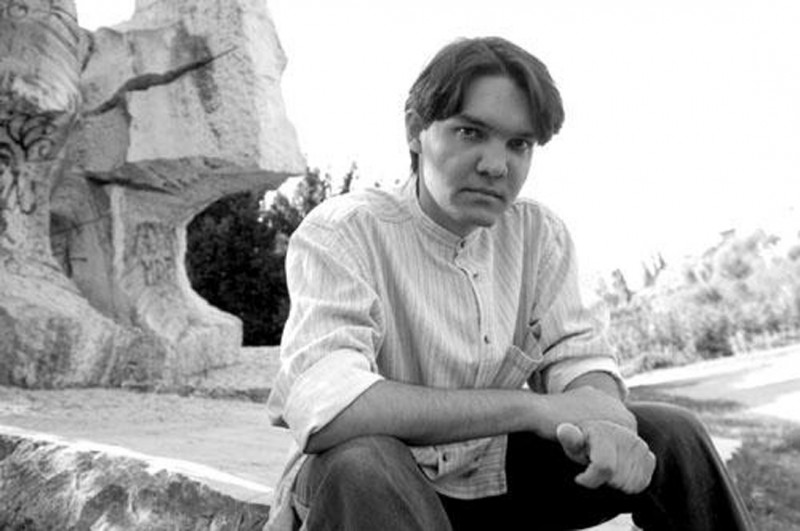
Tamás Jónás (b. 1973, Ózd, Hungary) is a Hungarian Roma poet and prose writer and one of the distinctive voices of contemporary Hungarian literature. His writing moves between poetry, autobiographical prose and fiction, often drawing on experiences of childhood, family, marginalisation, intimacy, faith and belonging while resisting the expectation that Roma identity should itself become the subject of his literature. His prose is characterised by a direct, sensorial language, fragmentation and a refusal to over-explain: bodily details, gestures and shifts between memory, document and fiction allow the reader to construct meaning rather than being given a predetermined emotional interpretation.
His major publications include Cigányidők / A forrás (1997; republished 2023), Bentlakás (1999), Önkéntes vak (2008), Apuapuapu (2013), Törzs (2016), and the novel Kívülálló (2023). His work has also appeared in German and Czech translation, including Als ich noch Zigeuner war (2006), 35 (2008) and Tatitatitati (2019). His latest novel, Volt egy kislány is velem (There Was Also a Little Girl with Me), is forthcoming in October 2026.
Jónás has received numerous literary awards and fellowships, including the Arany János Prize (1999), Herder Fellowship (2002), Móricz Zsigmond Fellowship (2005), Artisjus Literary Prize (2006), Zelk Zoltán Prize (2008) and Aegon Art Prize (2009), one of Hungary’s major literary distinctions. In 2026, he was selected for the DAAD–ERIAC Literature Residency in Berlin.

Carmen Baltzar (Helsinki / Lisbon) is a Finnish-Romani artist working across writing, film, performance and visual arts. Her work creates language and ritual for loss and transformation, metabolizing impermanence through inherited languages of rhythm, storytelling, incantation and spell. Her lyrical debut novel, carmen (2026), is published in Finnish by Kosmos. She co-adapted carmen into the short opera love is a rebellious bird, which premiered at the Finnish National Opera in 2026. Her short film all the love in my body premiered in the international competition at Krakow Film Festival in 2026, and screens at Sarajevo International Film Festival, Helsinki Film Festival, Nordisk Panorama, and others. She holds a BSc in Psychology from City University London and an MA in Ethnographic and Documentary Filmmaking from UCL, and is a member of the Romani Filmmakers Network (RFN).

Damian James Le Bas, British Romani writer, filmmaker, and cultural contributor. His first book, The Stopping Places (2018), received the Somerset Maugham Award and the Royal Society of Literature Jerwood Award, and was shortlisted for the Stanford Dolman Travel Book of the Year. Widely published as a journalist and poet, he has taught for the Arvon Foundation, is a member of the European Film Academy, and continues to write, direct, perform, and lead workshops internationally.

Anna Mirga-Kruszelnicka, Executive Director of the European Roma Institute for Arts and Culture (ERIAC), is a Polish Roma anthropologist, scholar, and one of the leading voices in Critical Romani Studies. She has authored and edited numerous publications on Roma political mobilisation, cultural representation, and the remembrance of the Roma genocide.