ERIACNET4EU: ERIAC NETWORK TO ADVANCE ROMA INCLUSION BY COMBATTING AND PREVENTING ANTIGYPSYISM IN THE EU
#ERIACNET4EU
In the frame of the Citizens, Equality, Rights and Values Programme (CERV) of the European Union, ERIAC is launching a new project: ERIACNET4EU: ERIAC NETWORK TO ADVANCE ROMA INCLUSION BY COMBATTING AND PREVENTING ANTIGYPSYISM IN THE EU.
PROJECT DESCRIPTION:
With the adoption of the new EU Roma Framework, the EU and its member states move towards implementation where expert advice as well as reliable partners on all levels of policy-making and implementation (local, regional, national, European) are needed.
ERIACNET4EU project will offer the expertise, specific know-how and reliable methodologies to support the implementation of the new framework.
ERIACNET4EU project aims at protecting, promoting and raising awareness of rights of Roma citizens of the EU and thereby at strengthening the EU values, in particular of equality, justice and non-discrimination and thus contributing to building a more democratic EU where all citizens can enjoy equal access and protection of their rights. It aims to do so by providing support to ERIAC network members, including civil society organizations active at local, regional and transnational level, to increase their capacities, establish channels of communication and participation with public authorities and EU institutions to ensure their active engagement in policy implementation and design targeting Roma. At the same time, it will result in providing informed, reliable, consolidated and quality input to European and national policy-makers and public institutions, to increase the effective implementation of strategies and laws that affect the lives of Roma in the EU.
ERIACNET4EU serves the following objectives:
Ensure quality input to policy-making and policy-implementation at local, regional, national and EU levels through mutual learning and exchange of good practices among/ between ERIAC members as well as with other public and private stakeholders
Awareness raising, information and dissemination activities
Increasing capacities and knowledge-base of members and other stakeholders through training activities
Growing the network and community outreach
Do you have any questions regarding ERIACNET4EU project? Feel free to reach out to us at eriac@eriac.org
ERIACNET4EU 2026 Higlights
ERIACNET4EU Grant Call | Submit Your Project
With the long-term goal of strengthening an open, rights-based, democratic, equal, and inclusive society in the EU through culture and cultural diplomacy, the European Roma Institute for Arts and Culture (ERIAC) invites applications from its EU-based member organisations.
The call supports initiatives that challenge negative narratives about Roma in Europe and boost self-esteem within Roma communities through arts, culture, history, education, media, advocacy, cultural diplomacy, and intercultural exchange between Roma and non-Roma communities.
We are looking for projects with a clear European dimension that:
strengthen capacity to protect and promote EU rights and values and increase citizen awareness of EU rights and values
contribute to the fight and prevention of antigypsyism, by employing counter-narratives through arts, culture, history, education and the media and a higher degree of Roma participation and self-representation
advocate for Roma cultural inclusion and a holistic and preventive approach to fighting antigypsyism and in doing so contribute to policy-making processes affecting the Roma
strengthen the organisations and leaders in the Roma movement through networking and collaboration between Roma and non-Roma led civil society organisations
challenge dominant, harmful narratives about Roma and present alternate narratives that incorporate culture and Romani contribution to the EU and seek to broaden the base of supportive allies, as well as foster a sense of pride and positive identity among Roma
Boost a sense of self-esteem, ethnic pride and belonging among Roma communities
Use arts and culture to encourage civic participation and reinforce democratic values.
General Objective:
Strengthen the capacity to protect and promote EU rights and values while increasing citizen awareness of these fundamental principles.
Specific Objectives:
Foster an open, rights-based, democratic, equal, and inclusive society in the EU through cultural initiatives and cultural diplomacy at local and regional levels.
Challenge and transform dominant, harmful narratives about Roma by highlighting their cultural contributions and engaging Roma and non-Roma stakeholders in intercultural dialogue.
Strengthen a sense of pride, unity, positive identity and ethnic belonging among Roma through arts, culture, history, education and the media and a higher degree of Roma participation and self-representation.
Build on the achievements of ERIACNET4EU by launching a targeted regranting scheme designed to scale and amplify initiatives that directly reach grassroots Roma communities, strengthening on-the-ground impact and embedding EU values into local actions and community-led activities.
Strengthen Roma organizations and leaders through collaborative networks and partnerships with civil society organizations.
Promote gender equality and combat gender-based stereotypes, especially through targeted initiatives for Roma women and girls.
Provide financial support to grassroots Roma-led and pro-Roma initiatives that promote civic participation and help implement EU values at the local level.
The call for projects will be launched respecting the principles of transparency, equal treatment, non-conflict of interest, and confidentiality.
The main goal is to provide project-based support to ERIAC member organisations based in the EU, enabling them to develop cultural activities focusing on awareness raising, commemoration, remembrance, research and education, with aim to explore shared European aspects of Romani history to further discuss current European challenges and Roma experience as a shared European narrative that defines European values of diversity, tolerance and fundamental rights. The projects should employ broadly understood arts and culture to strengthen democratic values and civic behaviour. Special attention will be given to initiatives which engage with large Roma communities, either physically or digitally, ensuring access to quality cultural programming on the grassroots community level.
FUNDING PRIORITIES
Projects must align with the following objectives:
Protect and promote EU values, non-discrimination, and equality.
Encourage civic engagement and raise awareness of Roma contributions to European identity and culture.
Address antigypsyism through educational initiatives, public campaigns, and cultural diplomacy.
Promote greater awareness of Roma history, culture, heritage, and experiences.
Strengthen the inclusion of Roma in mainstream cultural institutions and events.
Enhance leadership and civic participation within Roma communities, focusing on Roma women and youth.
Grant Structure and Eligibility Grant Categories:
Large scale projects: Up to €15,000 each.
Medium scale projects: Up to €10,000 each.
Indicative number of grants awarded: 8-10, with the total investment of 100.000,00 EUR
The number of grants awarded will depend on both the quantity and quality of received applications. The Jury may decide on granting contributions that are less than the originally applied amount, provided that the potential beneficiaries give their prior consent.
The rate of the project funding is 100%. Grantees are not required to provide self-contribution. The granted amount will be paid upon signing of the grant contract.The project should be budget-based, with the actual costs calculation method.
Eligibility Criteria:
Only ERIAC member organizations based in EU Member States are eligible.
Applicants must be legal, non-profit entities with demonstrated adherence to EU values as outlined in Article 2 of the Treaty on European Union.
Projects must be implemented within the EU or its overseas territories.
Applications should explicitly address one or more of the program’s funding priorities, with clear, achievable objectives and measurable outcomes.
Proposals must integrate a gender-sensitive approach during design and implementation.
Projects must include KPIs and impact assessment elements.
Eligible Activities (non-exhaustive list):
Cultural and commemorative events (exhibitions, performances, workshops, and conferences)
Permanent or temporary interventions in public spaces that aim to document and commemorate local histories and personalities
Research and educational initiatives, including the development of teaching materials and community-level educational initiatives
Awareness-raising campaigns and public communication efforts
Training, capacity-building activities, and cross-border learning exchanges
Initiatives promoting Roma visibility in arts and public spaces
Community-centered grassroots initiatives
Duration of projects:
All projects need to conclude by December 31, 2026
TIMELINE
01 May, 2026 Deadline for application submission
15 May, 2026 Jury meeting
20 May 2026 Grantees informed of decision
25 May 2026 Deadline to submit eventual changes requested by the jury
29 May 2026 Signing of the grant contracts
12 June 2026 Grant Management Training to be delivered to the grant recipients
Application Procedure
Applicants will be required to submit an application in English via an online application form. The applicant will also be required to provide a declaration of absence of conflict of interest and a declaration of adhering to EU values and rights and the respect of ERIAC founding principles.
Applicants must submit:
Project description with the detailed activity plan
Financial plan for the project costs for audit purposes
The selection procedure will comply with the principles of proportionality, sound financial management, equal treatment and non-discrimination. The procedure will also prevent the existence of conflicts of interest. The beneficiaries will be selected on a competitive basis, evaluated on the relevance of the application, quality of the proposed initiative and originality of their proposal.
REVIEW, RANKING AND DIAGNOSIS: ERIAC will analyze, on a weekly basis, the number of applications registered in order to find out if additional support actions are needed.
PROPOSALS RECEPTION BY ERIAC MANAGEMENT: Proposals will be only submitted through ERIAC website. On the receipt of each proposal, the system will send an Acknowledgement of receipt. Late submissions will not be accepted.
ELIGIBILITY CHECKS BY THE ERIAC STAFF: The system will generate a ‘List of Applications’ received. Proposals will be reviewed according to the ‘eligibility criteria’. Proposals which do not comply with the ‘eligibility criteria’ will be excluded from shortlisting at ‘Eligible Applicants List’. All applications will be reviewed considering the possibilities of conflicts of interest.
Submission and Eligibility Check:
Applications will be submitted via the ERIAC online platform.
An initial eligibility check will be conducted by the ERIAC management team.
Evaluation Committee Review:
SELECTION COMMITTEE REVIEW:
The package with all eligible applications will be forwarded to the Selection Committee. The Selection Committee members will be invited to review all applications, working independently. Selection Committee members will be provided with an evaluation form and an online surface to work. Once all the individual evaluations are done – based on the ‘selection criteria’ – the final score will be calculated as an average of the individual assessments provided by the Evaluators. As a result, the ‘Ranking List’ for the Call will be elaborated. The Selection Committee will meet to discuss the results and reach a consensus on the final list of winners.
Proposals meeting eligibility criteria will be evaluated based on:
Alignment with EU policy objectives and funding priorities.
Innovation, creativity, and originality of the proposal.
Potential for sustainable, long-term impact and contribution to EU values.
Attention to gender and diversity.
Collaborative, cross-thematic, and interdisciplinary approaches.
European dimension;
Collaborative projects which strengthen cooperation and different Roma groups identities, and reinforce intra-ethnic solidarity;
Multiplier effect, benefiting directly or indirectly, Roma families, communities and majority society at large, including through contributions to other ongoing Roma-led initiatives in the field.
Ranking and Selection:
Applications will be scored, and a ranking list will be developed based on evaluation criteria.
The final selection will be confirmed by the Evaluation Committee.
Announcement of Winners:
Results will be published on the ERIAC website, detailing project descriptions, awarded amounts, and project durations.
GRANT CALCULATION CRITERIA
During the selection procedure of the project, the evaluators will pay special attention if the content follows the financial framework given in the project application. The selection committee has extensive experience in both grant awarding the implementation, which ensures the relevance of their skills and knowledge when it comes to the relevant budgetary need for the activities proposed. In addition, all project components will be valued separately according to the eligibility criteria of the grant calls. In case of noneligible activities, the grant amount will be adapted in line with the accepted activities. Calculating criteria will be based on the cost of each project activity from the holistic perspective, including all activity costs arising and consequently if needed adapted.
The selection committee is composed by 4 members delegated by the Barvalipe Academy and 1 member delegated by ERIAC Management.
GRANT DISTRIBUTION AND MONITORING
Grant Agreements:
Upon selection, grant agreements will be signed between ERIAC and the beneficiaries.
The 100% of the grant amount will be disbursed upon signing.
Monitoring and Reporting:
ERIAC will conduct interim and final evaluations to track progress, ensure financial accountability, and identify challenges.
Beneficiaries will submit regular reports detailing project milestones, financial expenditures, and measurable outcomes.
Indicators for Success:
Number of cultural and commemorative events organized.
Number of participants in educational and training activities.
Media coverage and reach of awareness-raising campaigns.
Increased visibility of Roma contributions in arts and public spaces.
Impact assessments, including feedback from participants and stakeholders.
Ensuring Alignment with EU Priorities:
The grant-making program is directly aligned with the EU’s core objectives, including the promotion of equality, combating discrimination, and enhancing civic engagement.
The initiatives supported will feed into broader EU strategies, such as:
The EU Roma Strategic Framework (2020-2030), emphasizing the importance of Roma cultural inclusion.
The European Anti-Racism Action Plan, through targeted efforts to combat antigypsyism.
The New European Agenda for Culture, by promoting Roma heritage as part of Europe’s cultural diversity.
The Gender Equality Strategy, through initiatives that uplift Roma women and address intersecting forms of discrimination.
Sustainability and Long-Term Impact:
Projects funded under the grant will be designed for long-term impact, with an emphasis on creating sustainable networks and collaborations.
Lessons learned and best practices will be documented and shared across the ERIAC network to foster replication and scalability.
By leveraging the power of culture, history, and community engagement, this grantmaking initiative will contribute to a more inclusive, tolerant, and rights-based European society, ensuring Roma voices are heard and valued across Europe.
ERIACNET4EU 2025 Higlights
Kick-Off Meeting and Public Launch of ERIACNET4EU 2025
As part of the European Union’s Citizens, Equality, Rights, and Values Programme (CERV), ERIAC is excited to announce the next phase of its project: ERIACNET4EU – The ERIAC Network for Advancing Roma Inclusion by Combating and Preventing Antigypsyism in the EU. We invite you to join us on February 27, 2025, at 15:30 CET for an online public launch event. This event will offer a platform for engaging discussions on strategies and methodologies aimed at addressing antigypsyism and promoting a more inclusive and harmonious Europe.
The event will also introduce the 2025 grant application call for ERIAC member organizations, providing key information on eligibility, available support, budget, and matching fund requirements. Additionally, there will be an opportunity to discuss the upcoming implementation of the ERIACNET project for 2025. For more details, please refer to the event agenda.
February 27, 2025
15:30 – 17:00 CET
Link for participants: https://us02web.zoom.us/j/88296103278
Save the date and let us work together towards a more democratic EU where all citizens can enjoy equal access and protection of their rights.
OPEN CALL 2025 | ERIAC Grant-making to Protect and Promote EU Values and Rights
European Roma Institute for Arts and Culture (ERIAC) announces the new round of grants in 2025 under the ERIANCET4EU project, funded by the Citizens, Equality, Rights, and Values Programme (CERV) of the European Union.
With a long-term goal of using culture and cultural diplomacy to strengthen open, rights-based, democratic, equal and inclusive society in EU, the European Roma Institute for Arts and Culture (ERIAC) is inviting applications from its member organisations based in the EU that seek to change narratives about Roma in Europe through advocacy, cultural diplomacy and intercultural exchange between Roma and non-Roma.
We are looking for projects with a clear European dimension that:
strengthen capacity to protect and promote EU rights and values and increase citizen awareness of EU rights and values
contribute to the fight and prevention of antigypsyism, by employing counter-narratives through arts, culture, history, education and the media and a higher degree of Roma participation and self-representation,
advocate for Roma cultural inclusion and a holistic and preventive approach to fighting antigypsyism and in doing so contribute to policy-making processes affecting the Roma
strengthen the organisations and leaders in the Roma movement through networking and collaboration between Roma and non-Roma led civil society organisations,
challenge dominant, harmful narratives about Roma and present alternate narratives that incorporate culture and Romani contribution to the EU and seek to broaden the base of supportive allies.
The call for projects will be launched respecting the principles of transparency, equal treatment, non-conflict of interest, and confidentiality.
FUNDING CRITERIA:
The main goal is to provide project-based support to ERIAC member organisations based in the EU, enabling them to develop cultural activities focusing on awareness raising, commemoration, remembrance, research and education, with aim to explore shared European aspects of Romani history to further discuss current European challenges and Roma experience as a shared European narrative that defines European values of diversity, tolerance and fundamental rights. ERIAC funding priorities extend to initiatives that:
Protect and promote EU values, rights, non-discrimination and equality and promote citizen’s engagement and participation in the democratic life of the EU and exchanges between citizens of different Member States, and raise awareness of common European history,
Foster a sense of pride in shared Roma identity and strengthen leadership skills and civic participation of Roma in EU society,
Transform research, memorial sites and/or testimonies of Romani history into practical educational tools for civic education,
Promote presence of Roma in public spaces and the inclusion of Roma in institutions and events of majority arts and culture.
Support initiatives that enhance pride and identity within Roma communities by celebrating cultural heritage, strengthening collective self-confidence, and fostering intergenerational dialogue.
GRANT STRUCTURE:
The grants will be awarded for a minimum of 2 months and a maximum of 6 months project period through the following tranches:
Large grants in amount of 10.000-20.000,00 EUR (60.000 Euros)
Small grants in amount of 2.000 – 5.000 EUR (27.000 Euros)
The rate of the project funding is 100% and grantees are not required to provide self-contribution.
The Selection Jury may decide to change the total indicative amounts for each type of grants.
The grants will be paid in one installment: 100% of the amount will be transferred upon signing the contract. During their project implementation, grantees will be required to complete an impact assessment by regularly adding information in a template that will be provided together with the grant contract. This will allow ERIAC to track the results achieved.
Final Report: Final reports are expected within one month after the project’s conclusion.
ELIGIBILITY CRITERIA:
Applications are accepted from ERIAC member organizationsfrom EU Member States.
The applicant must be a legal entity, non-profit organization, established in a Member State of the European Union, and respecting EU values as laid down in Art.2 of the Treaty on European Union and the EU Charter of fundamental rights.
Natural persons are not eligible to apply, but the preference is given to applications for collaborative projects involving individual ERIAC members or non-EU-based members.
Project activities happening physically must take place on the territory of the EU.
The project must be designed to advance one or more of the funding priorities. It must have clear objectives that are achievable within the term of the project, which cannot extend beyond one year.
Organizations which have been awarded in 2024, are eligible to apply in 2025. Applicants can submit only one proposal.
ERIAC will provide support to activities which have EU added value, contribute to the implementation of the general program objectives and which reflect the purpose and priorities included in this call. The activities shall fall within the scope of one or more ERIAC thematic sections and should be guided by ERIAC founding principles.
The eligible activities may include but are not limited to:
Cultural events, including exhibitions, performances, concerts or workshops;
Commemoration activities and assemblies in memorial sites, such as erecting memorials or plaques;
Development of educational materials and/or publications;
Research and analytical activities;
Training and capacity building activities;
Conferences;
Mutual learning activities;
Awareness-raising campaigns;
Communication and dissemination activities.
Activities should duly pay attention to gender perspective, both at design and implementation phase, as this will be taken into account in the evaluation.
SELECTION CRITERIA:
The beneficiaries will be selected on a competitive basis, evaluated on the relevance of the application, quality of the proposed initiative and originality of their proposal. The Selection Committee will in particular pay attention to:
Alignment with the objectives of the program;
European dimension;
Possibility of sustainable, long-term impact;
Attention to gender perspective;
Interdisciplinary initiatives which transgress borders of art genres and cultural spheres;
Original ideas which connect and work across multiple thematic sections of ERIAC;
Collaborative projects which strengthen cooperation and different Roma groups identities, and reinforce intra-ethnic solidarity;
Innovation, ingenuity, creativity and originality of the proposal;
Multiplier effect, benefiting directly or indirectly, Roma families, communities and majority society at large, including through contributions to other ongoing Roma-led initiatives in the field.
Successful applicants will be notified at the end of May 2025
How to apply?
Proposal can be submitted between March 7, 2025 – May 7, 2025. Applications received later will not be considered.
Applicants are required to submit an application in English via the online application form.
Additionally, applicants will be required to submit:
Annual Financial Report
Previous Project Management Experience Report, for example by submitting a narrative activity report from the previous year.
Project Budget and the Activity Timetable of the Proposal in the format provided by ERIAC.
Download templates in the format provided by ERIAC:
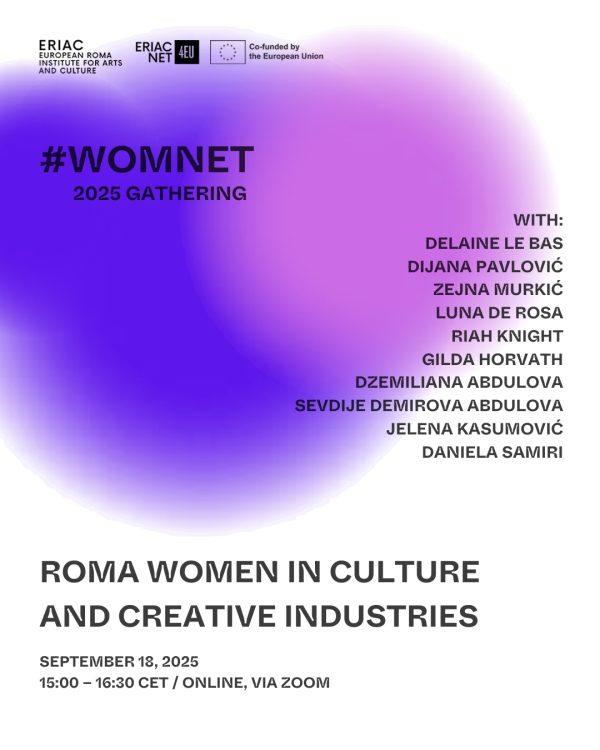
On the occasion of International Equal Pay Day, the 2025 edition of the WOMNET gathering—organized by the European Roma Institute for Arts and Culture (ERIAC)—invites reflection on the leadership and innovation of Roma women in arts, culture, and entrepreneurship.
On 18 September 2025, ERIAC convenes a distinguished group of Roma artists, cultural entrepreneurs, and managers to exchange practical strategies for building and sustaining creative careers. The event, hosted online via Zoom, is open to the public and welcomes dialogue, contributions, and personal reflections. Please register HERE by September 17th 2025, CoB, CET
ERIAC WOMNET is a safe space for Roma women and allies to connect, share wisdom, and celebrate creativity and leadership. This is more than a meeting—it is a circle of voices shaping the future of Roma women in the cultural and creative world.
WOMNET is part of the ERIACNET4EU initiative, which works to protect, promote, and raise awareness of the rights of Roma citizens in the EU while reinforcing core European values of equality, justice, and non-discrimination. It strives toward a more democratic Europe where all citizens enjoy equal access to and protection of their rights.
We are all responsible for creating a respectful and supportive environment. Together, we commit to upholding the values and policies that guide us, forming a temporary community during our time together. Maintaining this space with intention, care, and accountability is a shared responsibility. All exchanges should be rooted in respect, intention, and care. ERIAC’s founding commitment to diversity underpins this space. Share as much or as little as you feel comfortable with, your boundaries are valid, and there is no need to apologize for them. The event will be conducted in English, with parts of the program held in Romanes. A zoom link will be provided upon registration. For assistance, please contact nadja.greku@eriac.org
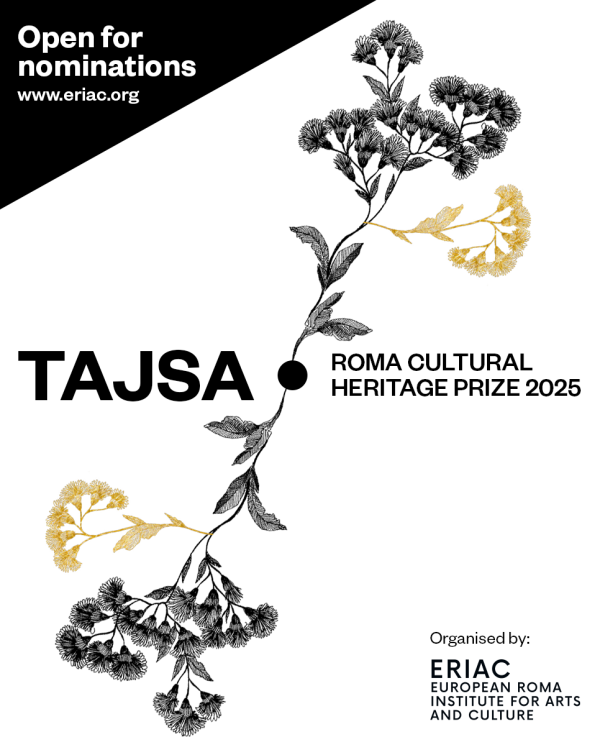
Tajsa Prize 2025 – Nominations Now Open for the Roma Cultural Award
The Tajsa Prize reflects ERIAC’s founding values and celebrates the depth of Roma history and culture, while championing new, future-facing forms of Roma artistic expression. It recognizes exceptional Roma individuals who are among today’s leading cultural voices, and aims to foster Roma pride by highlighting the imagination, excellence, and talent of Roma creators.
The prize is awarded every two years and is financed by ERIAC associate members, embodying Roma contribution and self-determination.
The 2025 endowment is €10,000.
Who Can Be Nominated (Eligibility)
A Roma individual (from any group of Roma people) working in arts and culture or knowledge production.
No restrictions based on nationality, age, gender, or sexual orientation.
Public nominations are welcome; anyone may nominate.
Not Eligible
Self-nominations.
Past Tajsa laureates.
Members of the Barvalipe Academy and ERIAC Board (to avoid conflicts of interest).
Fields and Genres (including but not limited to)
Visual arts (painting, sculpture, installation)
Film & moving image (cinema, video, animation)
Photography & design (graphic, product, fashion)
Performing arts (theatre, performance)
Dance & music (composition, performance, sound)
Literature & poetry (fiction, non-fiction)
Media & storytelling (journalism, podcasting, producing)
Scholarship & critical practice (research, knowledge production, cultural critique)
Selection Process
A 5-member international Jury:
1 ERIAC Board representative,
3 Barvalipe Academy members,
ERIAC’s Executive Director,
reviews all eligible nominations and selects five finalists. Finalists will be publicly presented by ERIAC. The winner is then chosen by a broader voting body consisting of the ERIAC Board (5), Barvalipe Academy (15), and the Executive Director, via anonymous ballot. The laureate will be revealed at the Tajsa Prize Ceremony on November 29, 2025, at the Romanian Athenaeum in Bucharest.
Timeline (2025)
September 15: Nominations open
October 15: Nominations close
October 24: Jury selects 5 finalists
November 4: Finalists announced
November 29: Award ceremony; winner announced
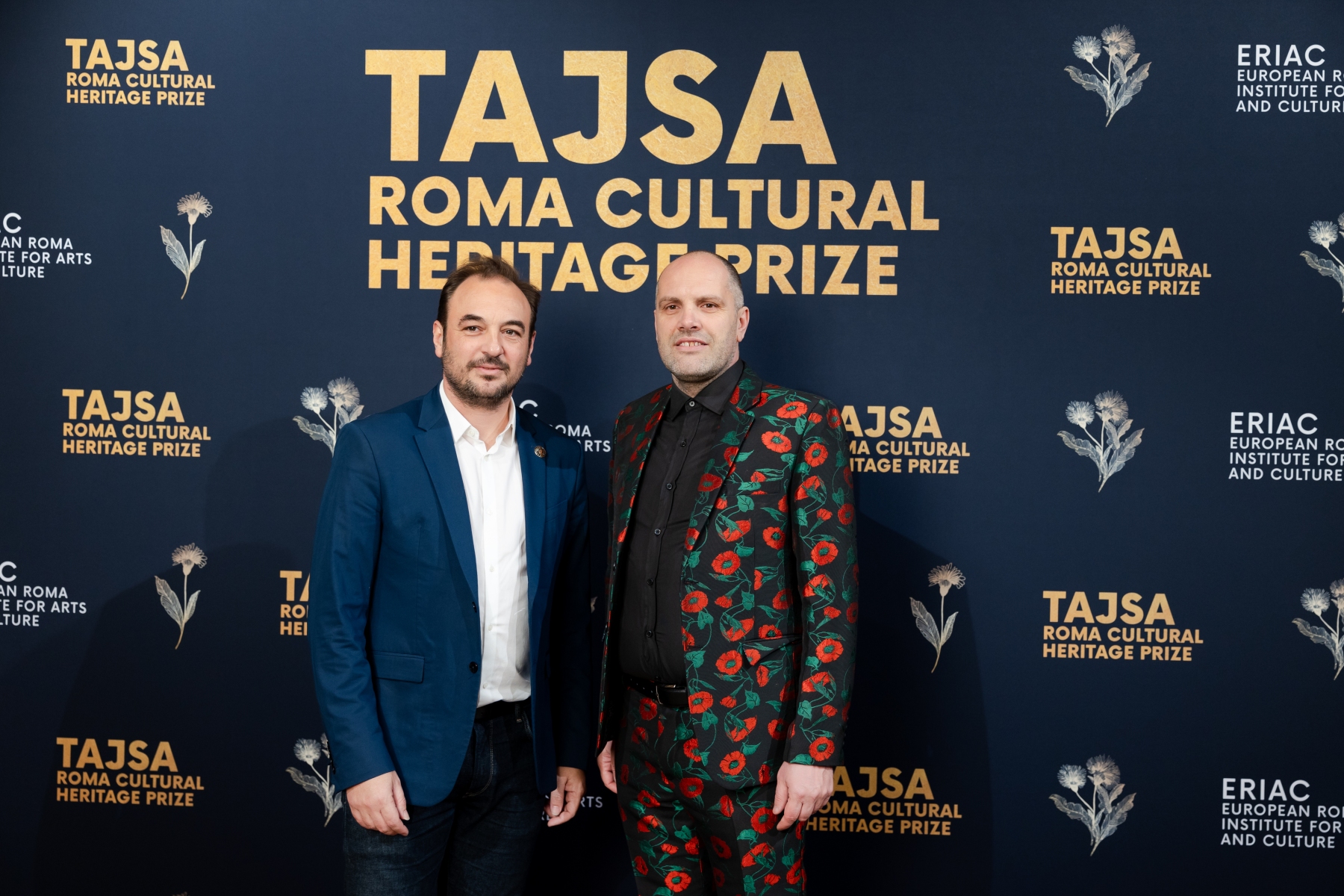
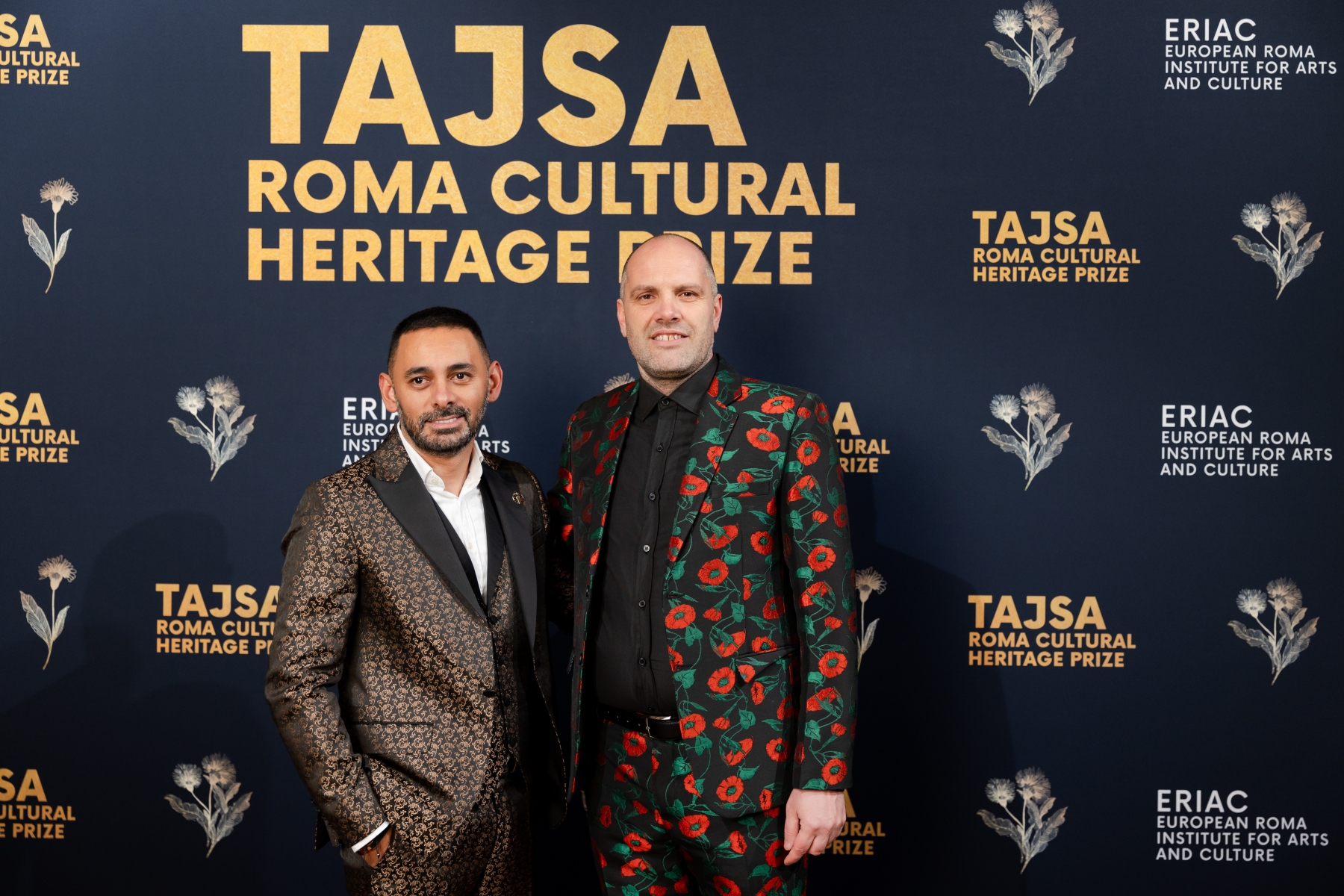
The 2025 Tajsa Cultural Heritage Prize Ceremony is co-financed by the Federal Foreign Office and the European Commission within the framework of the ERIACNET4EU project, alongside ERIAC.
ERIACNET4EU | Building a Database of Roma Journalists and Media Outlets
The European Roma Institute for Arts and Culture (ERIAC), within the framework of the ERIACNET4EU project, is launching a survey to map and connect Roma journalists, media professionals and Roma media outlets across Europe.
The aim of this initiative is to make visible the presence and contributions of Roma media actors, to foster cooperation, and to amplify Roma voices within the European media landscape. By participating in this survey, you will contribute to documenting Roma media actors and their work, strengthening networks and collaboration among Roma media professionals, and enhancing the visibility and recognition of Roma voices in Europe’s media environment.
All responses will be treated with full confidentiality and processed in compliance with the General Data Protection Regulation (GDPR). The collected data will be used exclusively for research, documentation and advocacy purposes and will not be shared with third parties.
ERIAC warmly invites Roma journalists, editors, reporters, media workers and media outlets, both digital and print, to take part in this important effort. Together, we can ensure that Roma media voices are seen, heard and valued across Europe.
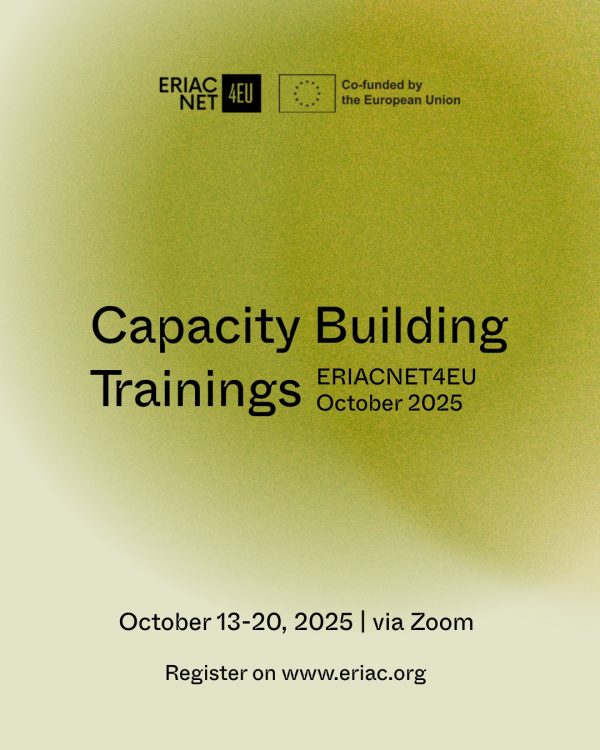
Capacity Building Trainings ERIACNET4EU October 2025
In the frame of the ERIACNET4EU project, financed by the European Commission, the European Roma Institute for Arts and Culture (ERIAC) is excited to announce a new series of capacity-building trainings taking place during October 2025. These workshops and seminars are designed to provide valuable skills, encourage collaboration, and support the preservation and promotion of Roma culture.
Organizing Advocacy-Focused Film Screenings Workshop
Objective: Learn how to use film as a tool for advocacy and community engagement. Gain practical guidance on planning screenings, finding funding, and engaging audiences, with resources from existing toolkits and romacinema.org.
Trainer: Sami Mustafa, independent documentary filmmaker, producer, and founder of the Rolling Film Festival and Romawood.
Practical AI Workshop: Tools, Risks & Opportunities
Objective: Understand biases and stereotypes in generative AI, while also discovering practical tools for writing, research, presentations, and creative work. Participants will leave with 2–3 workflows they can apply immediately.
Trainers:
Benjamin Ignac, Romani activist and researcher, specializing in AI ethics, Roma rights, and digital inclusion.
Luis Semprun, product engineering leader, expert in AI-driven transformation and workflow automation.
Ethical Research: Roma Knowledge Production Workshop
Objective: Explore decolonial, participatory, and reflexive research approaches. Learn tools for ethical collaboration with Roma communities and strategies for co-creation in Roma research.
Trainers:
Dr. Dezso Mate, sociologist, researcher on intersectionality, antigypsyism, and Roma movements.
Dr. Carol Silverman, cultural anthropologist and folklorist with decades of research on Balkan and Romani music and identity.
Heritage Documentation: Knowledge Transfer Workshop
Objective: Gain hands-on techniques for documenting and archiving Roma traditions. Explore intergenerational knowledge transfer, digital preservation tools, and lessons from the Fortunoff Archive for Roma cultural preservation.
Trainers:
Stephen Naron, Director of the Fortunoff Archive, expert in documentation, digital access, and preservation.
Dr. Maria Bogdan, media and cultural theorist specializing in Roma representation, cultural memory, and trauma.
On Curating Roma Art
Date: October 20, 2025
Time: 03:30 – 05:00 PM CET
Objective: Reflect on Roma presence in European art history and highlight the contributions of contemporary Roma artists. Provide practical guidelines for ethical curatorial practice and strategies for shifting representation from stereotype to agency.
Trainer:Timea Junghaus, is an art historian, curator, executive director at ERIAC and a leading voice of the Roma cultural movement. She curated Paradise Lost, the First Roma Pavilion at the Venice Biennale (2007), and has led pioneering international projects centering Roma art, resistance, and authorship
These sessions aim to strengthen Roma cultural agency and provide participants with concrete skills and knowledge. We look forward to your participation in these workshops.
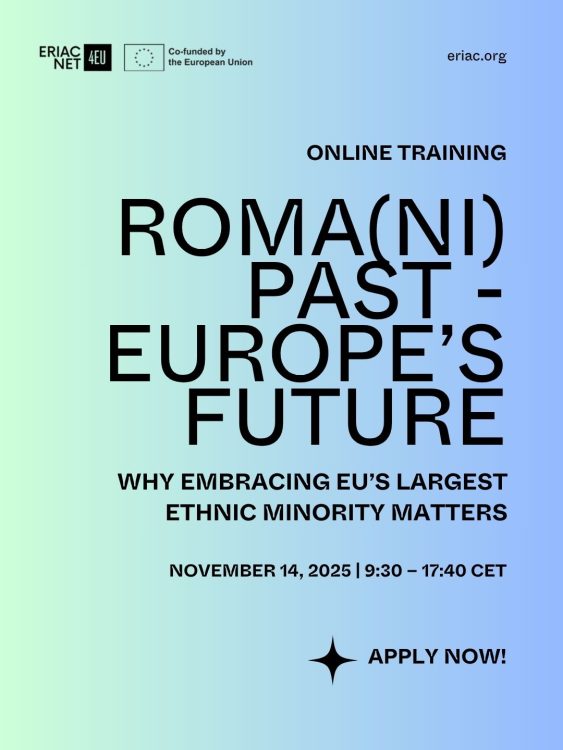
Online Training on Romani Identity, History and Culture
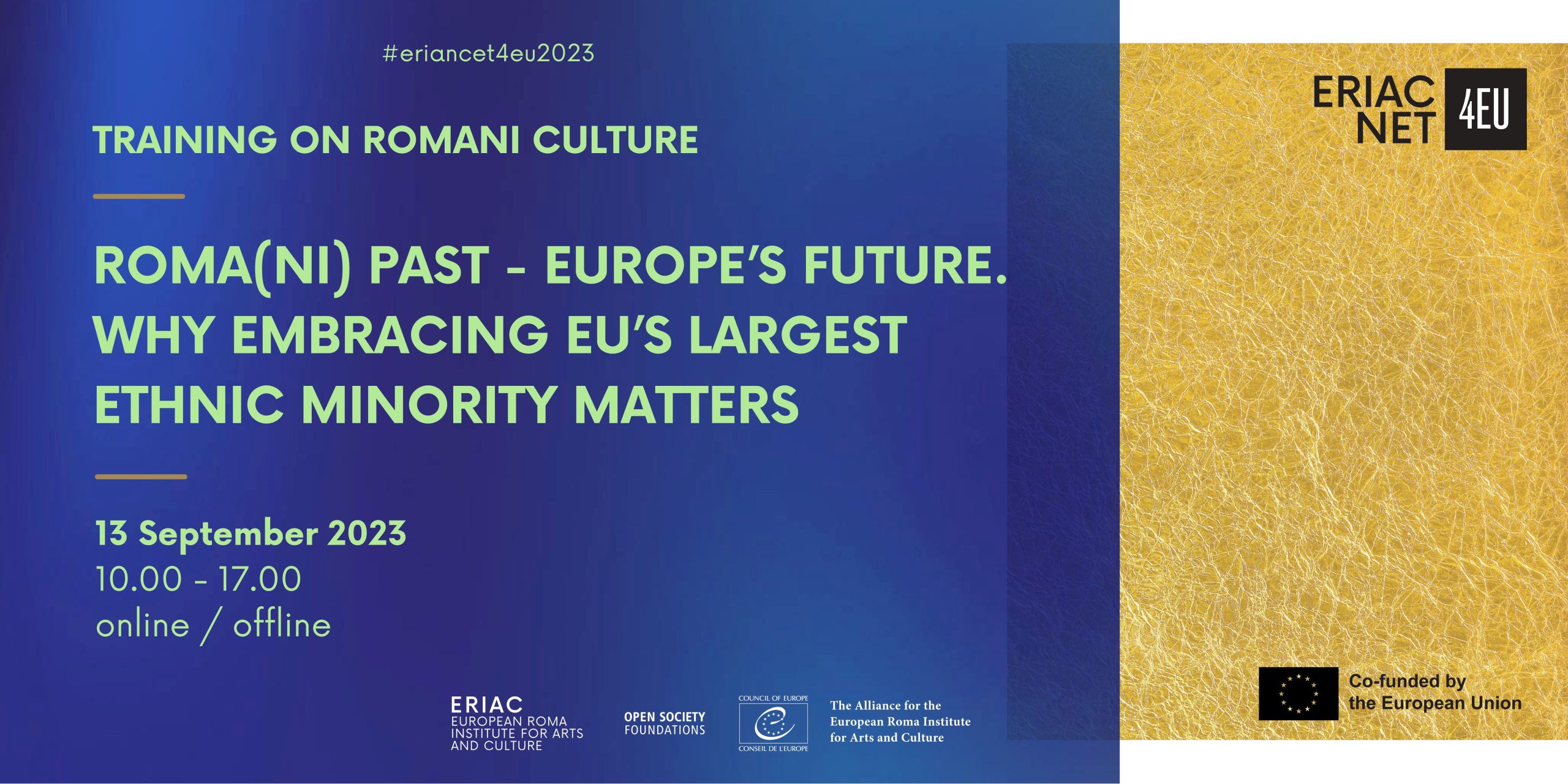
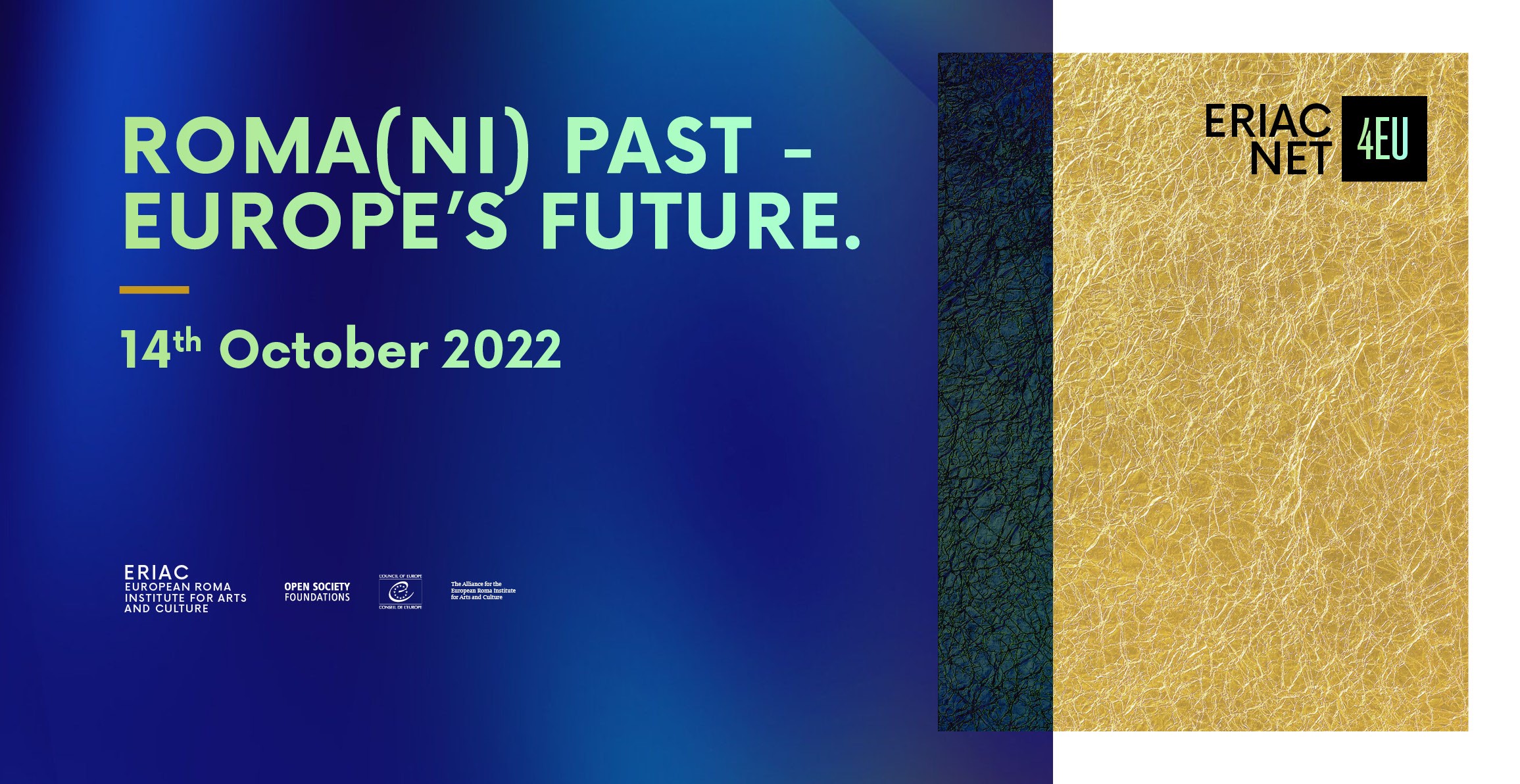
The European Roma Institute for Arts and Culture (ERIAC), is pleased to announce the online training Roma(ni) Past – Europe’s Future: Why Embracing the EU’s Largest Ethnic Minority Matters, dedicated to strengthening understanding of Roma identity, history, culture, and the realities of antigypsyism, organized within the framework of the ERIACNET4EU initiative.
This training aims to equip public officials, educators, cultural workers, and other professionals with the knowledge and sensitivity needed to better understand Roma experiences, recognize and challenge Antigypsyism, and support more inclusive and respectful practices. Participants will explore the evolution of Roma identity, the cultural contributions of Roma communities across Europe, and the structural forces that continue to shape inequalities today.
9:30 – 9:45 CET Welcome address and opening remarks
Anna Mirga-Kruszelnicka – Deputy Director, ERIAC
Presenting the agenda and speakers
9:45 – 11:00 CET“Roma Identity Through the Ages”
Trainer: Raul Cârstocea
This session will focus on Roma identity and its evolution through the ages. To do so, it will begin with a discussion of the ways in which ‘identity’ in general is understood in the social sciences and humanities, considering both self-identification and external ascription. We will then proceed to look at the history of Roma in Europe and how our present identity was historically constituted, at the interplay of factors operating both within and from outside the community. We will conclude with a reflection on where we are now in terms of self-representations of Roma identity, initiating a dialogue on how a Roma politics of the future could look like.
11:00 – 11:15 CETCoffee break
11:15 – 12:30 CET“Co-Governing the Future: Roma Politics and Europe’s Constitutional Horizon”
Trainer: Mensur Haliti
Europe’s democratic future will not be secured in its centers of power but along the frontier where its ideals confront the limits of their own architecture. Roma politics make that frontier visible. They expose how systems built to guarantee equality can, through repetition and hierarchy, reproduce dependence and suppress new forms of political agency. Yet within that tension lies a civic resource that Europe can no longer afford to overlook: a young, transnational, and steadfastly pro-European electorate whose belief in democratic belonging endures even as institutions lose faith in themselves. To engage Roma politics, therefore, is not an act of benevolence but of strategic necessity – an acknowledgment that Europe’s stability, legitimacy, and endurance as a political order will depend on how it learns to co-govern the shaping of future political systems alongside, and ultimately constitutive of, Roma.
12:30 – 13:30 CETLunch break
13:30 – 14:45 CET“Beyond Representation: Cultural Mediation and the Challenges of Contemporary Romani Creation in Europe’s Peripheries”
Trainer: Miguel Ángel Vargas
This session addresses the structural limits that contemporary Romani creation faces within the institutional frameworks of representative democracy in Europe. Drawing on five years of practice-based research in Seville’s Polígono Sur, I examine how public cultural programs and diversity policies often reformulate Romani experiences through the prism of “Gypsy/Roma culture” as a reflection of the aesthetic regime of visibility, rather than as a process of emancipation. The persistence of antigypsyism in public cultural policy – especially in urban peripheries – reveals how inclusion can operate as another form of control. In response, I propose cultural mediation not as ethnic brokerage but as an ethics of encounter.
14:45 – 16:00 CET“The Fundamentals of Anti-Roma Racism: From Historical Legacies to Structural Oppression”
Trainer: Margareta Matache
This lecture aims to define and unpack anti-Roma racism as a fundamental and permanent form of structural oppression in European societies. We will examine the historical genesis of anti-Roma racism, beginning with the racialized system of slavery in the Romanian principalities of Moldavia and Wallachia, and extending through centuries marked by expulsions, killings, and exclusions across Europe. Furthermore, we will analyse the mechanisms, legacies, and continuities of anti-Roma racism, situating these within broader global frameworks and theories of oppression, racism, racialization, and slavery.
16:00 – 16:15 CETCoffee break
16:15 – 17:30 CET“The Romani Holocaust: Memory, History, Representation”
Trainer: Ioanida Costache
Despite being one of the lesser-known aspects of the Holocaust, the genocide of the Romani people was systematic and devastating. This session will examine how the Romani Holocaust has been remembered – or forgotten – within broader Holocaust discourse and how Romani communities have sought to preserve their history. This seminar explores the history and memory of the Romani Holocaust through historical accounts, survivor testimonies, and contemporary efforts at commemoration. We will engage with historiographical debates, primary documents, and cultural representations to foster a deeper understanding of the impact and legacy of the Romani Holocaust.
17:30 – 17:40 CETClosing remarks
Objectives
The primary objectives of this training course are:
Increase Understanding of Roma Identity and History
Provide participants with a comprehensive overview of the origins and evolution of Roma identity, examining the historical contexts that have shaped Roma communities across Europe.
Highlight the resilience and adaptability of the Roma people in the face of centuries of marginalization and exclusion.
Recognize and Celebrate Roma Cultural Contributions
Illuminate the rich and diverse cultural heritage of the Roma, showcasing their contributions to European arts.
Encourage appreciation and integration of Roma cultural elements into broader European cultural narratives.
Address Antigypsyism and Promote Inclusion
Explore the roots and manifestations of Antigypsyism, equipping participants with the knowledge to recognize and challenge this form of racism in their professional and personal environments.
Discuss effective strategies for combating Antigypsyism and fostering an inclusive society that respects and values Roma people.
Empower Participants with Knowledge and Tools for Advocacy
Provide actionable insights and resources to support participants in advocating for Roma rights and promoting cultural understanding in their respective fields.
Encourage participants to engage with and support Roma communities through informed and culturally sensitive practices.
Expected Outcomes
By the end of the training, participants will:
Enhanced Awareness and Knowledge
Gain a deeper understanding of Roma identity, history, and the socio-cultural dynamics that influence Roma communities today.
Acquire knowledge of the historical and ongoing contributions of Roma to European culture and society.
Improved Sensitivity and Competence
Develop a greater sensitivity to the issues facing Roma communities, particularly in the context of Antigypsyism and other forms of discrimination.
Build competence in recognizing and addressing Antigypsyism within institutional and societal contexts.
Empowered to Act and Advocate
Be equipped with practical tools and strategies to advocate for Roma rights and inclusion in their professional roles.
Leave the training with a commitment to fostering a more inclusive and equitable society for the Roma and other marginalized communities.
Stronger Networks for Collaboration
Establish connections with other participants, trainers, and Roma communities, fostering a network of individuals committed to promoting Roma inclusion and cultural understanding.
Identify opportunities for future collaboration and continued learning on Roma issues.
Meet the trainers
Raul Cârstocea is Professor of History at Maynooth University and Principal Investigator on the ERC Consolidator Grant Insurgent Temporalities: Fascism as a Global Anti-Universalist Project (INTEMPO). His work focuses on the Holocaust, fascism, nationalism, and more broadly on state-building processes in modern Central, Eastern, and Southeastern Europe and their consequences for minority groups. He is a member of the Barvalipe Academy of ERIAC, Co-Convenor of the BASEES Study Group for Minority History, and co-editor of the Modern History of Politics and Violence book series at Bloomsbury. He has served as Vice-Chair of the Scientific Advisory Council (SAC) of the Observatory on History Teaching in Europe at the Council of Europe from 2021 to 2024, and as Chair of the SAC from 2024 to July 2025.
Mensur Haliti is Vice President for Democracy and Network Development at the Roma Foundation for Europe, Founder of the Roma for Democracy Foundation, and Board Chair of the European Roma Institute for Arts and Culture. He holds a Master of Public Administration from the Hertie School of Governance, with specialization in governing regimes and corruption control, and has completed executive programs at Harvard Kennedy School, MIT Sloan, and Oxford Saïd Business School. For more than two decades, Haliti has advanced Roma politics, institutional reform, and democratic governance across Europe’s most complex policy environments. As part of his doctoral research, Haliti is developing Romanipe: The Legal and Political Order of the Roma – a constitutional system that reconstructs over two millennia of Roma governance. His work demonstrates how Romanipe operates as a living constitutional order – enduring without territorial monopoly, codification, or external recognition. His research contributes to a new constitutional canon positioning Roma political thought as a sovereign tradition that informs the reconstruction of governance, affirms the legitimacy of Roma self-rule, and participates in the co-design of future political orders.
Miguel Ángel Vargas (Lebrija, 1978) is an Art Historian and Theatre Director. An independent researcher and artist who combines flamenco, theatre, and Romani history as experiential material for artistic and academic inquiry. He has worked internationally as an actor, director, set designer, curator, production manager, and cultural practitioner. Vargas has collaborated with academic institutions such as Central Saint Martins College of Arts (London) and the Critical Approach to Romani Studies Program at the Central European University (Budapest–Vienna); has advised cultural institutions including the National Gallery of Art (Washington) and Cultura y Ciudadanía (Spanish Ministry of Culture); and was a member of the Barvalipe Academy of ERIAC. Between 2021 and 2025, he was part of Seville’s municipal program for cultural mediation (ICAS). Since 2021, he has lectured in the Master’s program for Research and Analysis of Flamenco at the Universidad Pablo de Olavide, where he is also completing a PhD in Contemporary History focused on urban racialization.
Margareta Matache, PhD, is a Harvard Lecturer, co-founder, and Director of the Roma Program at Harvard University. She also serves on the Lancet Commission on Racism, Structural Discrimination, and Global Health. Matache is the co-editor of Time for Reparations: A Global Perspective (2021) and Realizing Roma Rights (2017). Her book, The Permanence of Anti-Roma Racism: (Un)uttered Sentences (Routledge), which explores anti-Roma racism and its specific and universal underpinnings, manifestations, and links to other oppressions, will be released in December 2025. With 25+ years in organizational leadership, policy advocacy, social change interventions, and academic work, she focuses on framing and addressing anti-Roma racism.
Ioanida Costache is Assistant Professor of Ethnomusicology and, by courtesy, Anthropology, at Stanford University. She is also an affiliate of the Center for Comparative Studies in Race and Ethnicity. Her work explores the legacies of Romani historical trauma, and the feminist critiques of the present, inscribed in Romani music, sound, and art. Her writing has been published in EuropeNow, RevistaARTA, Critical Romani Studies, and European History Quarterly. Her research has been supported by two Fulbright Grants and the Council of European Studies. She has held visiting and postdoctoral fellowships at the University of Pennsylvania, the United States Holocaust Memorial Museum, and the USC Shoah Foundation.
ERIACNET4EU Closing Event: Celebrating Four Years of Advancing Roma Inclusion
As part of the VIII ERIAC General Assembly, the European Roma Institute for Arts and Culture (ERIAC) is proud to announce the ERIACNET4EU Closing Event, taking place on 29 November 2025 in Bucharest and online.
The event marks the completion of four years of dedicated work towards advancing Roma inclusion and fighting antigypsyism in the EU – carried out through the ERIACNET4EU initiative and implemented under a Framework Partnership Agreement (FPA) with the European Commission.
The Closing Event will offer a moment to celebrate achievements and highlight ERIAC’s key activities between 2022 and 2025, which have been instrumental in bringing the ERIACNET4EU mission to life: organising training courses and capacity-building activities, hosting networking events and community outreach initiatives, and producing high-quality input for policy-making and implementation. These efforts have not only raised awareness but also opened new channels of dialogue with public authorities, ensuring that Roma perspectives shape policies at local, national, and EU levels.
A central part of the event will be dedicated to the Voices from the Network, featuring presentations from two ERIACNET4EU beneficiaries – Vera Lackova (Media Voice, Slovakia) and Fabian Sanchez (Asociacion Nacional Presencia Gitana, Spain) – who will share their experiences, creative outputs, and reflections on how the ERIACNET4EU regranting scheme supported their work.
In addition to taking stock of important accomplishments, the Closing Event will also introduce the next iteration of the initiative for 2026–2028. We look forward to welcoming our members, partners, and supporters to celebrate this milestone together.
Advancing Romani Media Representation and Production in Europe and Beyond: A Position Paper
As part of the ERIACNET4EU initiative in 2025, financed by the European Commission, and drawing on the expertise of the members of the ERIAC Media and Information thematic section, ERIAC is proud to present the Position Paper on Advancing Romani Media Representation and Production.
This year’s position paper examines the powerful role of the media in shaping public perceptions of Roma, confronting the legacy of antigypsyism reproduced in newsrooms, on screen, and across digital platforms. It highlights the urgent need to transform harmful media narratives that reinforce stigma and normalize exclusion into truthful and ethically grounded portrayals.
In line with ERIAC’s longstanding commitment to strengthening Roma self-representation, the paper highlights the need for Roma journalists, filmmakers, and storytellers to have equal access to the spaces where public discourse is shaped. It analyses contemporary media realities and offers concrete, forward-looking policy recommendations to diversify newsroom staffing, support ethical reporting, strengthen Roma-led media platforms, and amplify Roma voices in media governance and decision-making.
Building on the lived experiences and expertise of Roma media practitioners from Europe and beyond, this document serves both as an inspiration and a roadmap for policymakers, media regulators, public broadcasters, and civil society actors committed to dismantling antigypsyism and establishing meaningful pathways for Roma participation across the media landscape.
Read Advancing Romani Media Representation and Production in Europe and Beyond: A Position Paper
Strengthening Inclusion of Roma in European Museums and Cultural Institutions | Policy Recommendations
Across Europe, museums are redefining themselves as spaces of civic participation and ethical responsibility, placing inclusion at the core of cultural democracy. Within this shift, the marginalization of Roma communities remains a major challenge. Although Roma are Europe’s largest ethnic minority, they are largely absent from cultural institutions due to longstanding systemic barriers—not a lack of cultural production.
Roma artists and cultural workers have nonetheless developed rich practices, often outside institutional frameworks. European museums and cultural organizations now have a unique opportunity to address this imbalance by engaging with Roma culture in sustained, structural ways. Roma-led initiatives such as ERIAC, RomaMoMA, Romani Pen, Ake Dikhea, and RomArchive offer proven models for ethical collaboration.
The policy document Strengthening Inclusion of Roma in European Museums and Cultural Institutions, authored by Timea Junghaus, ERIAC Executive Director, curator and art historian, builds on these existing strengths. It proposes a framework that supports institutions and organizations in moving beyond symbolic representation toward meaningful partnership and shared authorship. It urges institutions to recognize that Roma cultural inclusion is not a thematic or temporary concern but a long-term investment in a more just, knowledgeable, and sustainable European cultural sphere.
The document was conceived as a follow-up to the workshop and discussion of the ERIAC Arts and Culture thematic section on April 23, 2025.
Open Call 2024 | ERIAC Grant-making to Protect and Promote EU Values and Rights
In the frame of the ERIANCET4EU project financed by the Citizens, Equality, Rights and Values Programme (CERV) of the European Union, and with a long-term goal of using culture and cultural diplomacy to strengthen open, rights-based, democratic, equal and inclusive society in EU, the European Roma Institute for Arts and Culture (ERIAC) is inviting applications from its member organizations based in the EU that seek to change narratives about Roma in Europe through advocacy, cultural diplomacy and intercultural exchange between Roma and non-Roma.
General objective of the call is to strengthen capacity to protect and promote EU rights and values and increase citizen awareness of EU rights and values.
We are looking for projects with a clear European dimension that:
strengthen capacity to protect and promote EU rights and values and increase citizen awareness of EU rights and values
contribute to the fight and prevention of antigypsyism, by employing counter-narratives through arts, culture, history, education and the media and a higher degree of Roma participation and self-representation,
advocate for Roma cultural inclusion and a holistic and preventive approach to fighting antigypsyism and in doing so contribute to policy-making processes affecting the Roma,
strengthen the organisations and leaders in the Roma movement through networking and collaboration between Roma and non-Roma led civil society organisations,
challenge dominant, harmful narratives about Roma and present alternate narratives that incorporate culture and Romani contribution to the EU and seek to broaden the base of supportive allies.
FUNDING CRITERIA
The program aims to provide project-based support to ERIAC member organizations based in the EU, enabling them to develop cultural activities focusing on awareness raising, commemoration, remembrance, research and education, with aim to explore shared European aspects of Romani history to further discuss current European challenges and Roma experience as a shared European narrative that defines European values of diversity, tolerance and fundamental rights. ERIAC funding priorities extend to initiatives that:
protect and promote EU values, rights, non-discrimination and equality and promote citizen’s engagement and participation in the democratic life of the EU and exchanges between citizens of different Member States, and raise awareness of common European history;
foster a sense of pride in shared Roma identity and strengthen leadership skills and civic participation of Roma in EU society;
transform research, memorial sites and/or testimonies of Romani history into practical educational tools for civic education;
promote the presence of Roma in public spaces and the inclusion of Roma in institutions and events of majority arts and culture.
GRANT STRUCTURE
The grants will be awarded for a minimum of 2 months and a maximum ofone-year period projects through the following tranches:
Small grants in amount of 5000 – 8000 Eur;
Large grants in amount of 10.000 – 20.000 Eur;
The rate of the project funding is 100%.
Pre-financing: Grants paid in two installments: 70% of the granted amount will be paid upon singing of the grant contract and 30% upon approval of the interim report
ELIGIBILITY CRITERIA
Applications are accepted from ERIAC member organizations from EU Member States.
The applicant must be a legal entity, non-profit organization, established in a Member State of the European Union, and respecting EU values as laid down in Art.2 of the Treaty on European Union and the EU Charter of fundamental rights.
Natural persons are not eligible to apply, but the preference is given to applications for collaborative projects involving individual ERIAC members or non-EU-based members.
Project activities happening physically must take place on the territory of the EU.
The project must be designed to advance one or more of the funding priorities. It must have clear objectives that are achievable within the term of the project, which cannot extend beyond one year.
Organizations which have been awarded in 2023, are eligible to apply in 2024. Applicants can submit only one proposal.
The eligible activities may include but are not limited to:
Cultural events, including exhibitions, performances, concerts or workshops;
Commemoration activities and assemblies in memorial sites, such as erecting memorials or plaques;
Development of educational materials and/or publications;
Research and analytical activities;
Training and capacity building activities;
Conferences;
Mutual learning activities;
Awareness-raising campaigns;
Communication and dissemination activities.
Activities should duly pay attention to gender perspective, both at design and implementation phase, as this will be taken into account in the evaluation.
SELECTION CRITERIA
The beneficiaries will be selected on a competitive basis, evaluated on the relevance of the application, quality of the proposed initiative and originality of their proposal. The Selection Committee will in particular pay attention to:
Alignment with the objectives of the program;
European dimension;
Possibility of sustainable, long-term impact;
Attention to gender perspective;
Interdisciplinary initiatives which transgress borders of art genres and cultural spheres;
Original ideas which connect and work across multiple thematic sections of ERIAC and which engage ERIAC different individual and institutional members;
Collaborative projects which strengthen cooperation across countries and different Roma groups identities, and reinforce intra-ethnic solidarity;
Innovation, ingenuity, creativity and originality of the proposal;
Multiplier effect, benefiting directly or indirectly, Roma families, communities and majority society at large, including through contributions to other ongoing Roma-led initiatives in the field.
Successful applicants will be notified in mid-June 2024.
How to apply?
Proposal can be submitted between March 25, 2024 – May 25, 2024. Applications received later will not be considered.
Applicants are required to submit an application in English via the online application form.
Additionally, applicants will be required to submit:
Annual Financial Report
Previous Project Management Experience Report, for example by submitting a narrative activity report from the previous year.
Project Budget and the Activity Timetable of the Proposal in the format provided by ERIAC.
Download templates in the format provided by ERIAC:
Kick-Off Meeting and Public Launch of ERIACNET4EU 2024: ERIAC Network to Advance Roma Inclusion by Combatting and Preventing Antigypsyism in the EU
Under the Citizens, Equality, Rights, and Values Programme (CERV) of the European Union, ERIAC is thrilled to launch the next phase of its project: ERIACNET4EU – The ERIAC Network to Advance Roma Inclusion by Combating and Preventing Antigypsyism in the EU. Join us on February 27, 2024, at 15:30 CET, for an online public launching event, fostering an engaging discussion on envisaged strategies and methodologies to combat antigypsyism and contribute to a more inclusive and harmonious Europe.
The event will unveil the 2024 call for grant applications for ERIAC member organizations, provide insights into eligibility, support types, budget, and matching fund requirements, and engage participants in discussions on the upcoming ERIACNET project implementation for 2024. For further details, please see the event agenda.
February 27, 2024
15:30 – 17:00 CET
Link for participants:
https://us02web.zoom.us/j/84433069661
Save the date and let us work together towards a more democratic EU where all citizens can enjoy equal access and protection of their rights.
ERIACNET4EU 2023 Higlights
Advancing Education and Roma Knowledge-Production in Europe and Beyond: A Position Paper
In the frame of ERIACNET4EU: ERIAC NETWORK TO ADVANCE ROMA INCLUSION BY COMBATTING AND PREVENTING ANTIGYPSYISM IN THE EU project in 2023, financed by the European Commission, and building on the input and experience – through survey responses, discussions, and written contributions – of the members of the ERIAC Knowledge-Production and Publication thematic section, ERIAC is proud to present the position paper “ADVANCING EDUCATION AND ROMA KNOWLEDGE-PRODUCTION IN EUROPE AND BEYOND: A POSITION PAPER”.
The aim of this position paper is to discuss strategies of advancing Roma culture, history, and education as a tool to challenge stereotypes and foster social and cultural inclusion of Roma communities in Europe. It delves into critical issues related to Roma education, knowledge production, and their broader implications. This paper highlights that while some progress has been made in the realm of Roma education, the educational disparities experienced by Roma students and scholars persist, indicating an urgent need for expansion and scaling up of lessons learned from leaders in Roma education. With a powerful foreword by dr. Ciprian Necula, Chairman of the Board of the Roma Education Fund (REF), the paper presents a comprehensive set of recommendations to foster inclusive education and combat discrimination, calling on a broad set of stakeholders to consider, adopt and implement the proposed recommendations. Key recommendations include, among other, the integration of Romani culture and history into educational curricula and the promotion of Romani scholarship. Bridging educational disparities is not just a moral imperative; it is also an economic necessity for the economic recovery of Europe and beyond. Roma communities make significant contributions to the labour market, paving the way for a more inclusive and prosperous future. By confronting antigypsyism, enhancing educational opportunities, and broadening the representation of Roma culture and history, Europe can work towards a more just, equitable and inclusive future for all.
Suggested citation: Mirga-Kruszelnicka, Anna & Mate, Dezso & Greku, Nadja: Advancing Education and Roma Knowledge-Production in Europe and Beyond: A Position Paper, Published by European Roma Institute For Arts And Culture (ERIAC), 2023
Małgorzata Mirga-Tas Wins Prestigious Tajsa Roma Cultural Heritage Prize 2023
The European Roma Institute for Arts and Culture (ERIAC) proudly recognizes Małgorzata Mirga-Tas as the distinguished recipient of the prestigious Tajsa Roma Cultural Heritage Prize 2023. Handpicked from an impressive array of over eighty submissions, Mirga-Tas stands as an exemplar of excellence and commitment in advancing Roma cultural heritage.
Małgorzata Mirga-Tas, a Polish-Roma artist celebrated for her vibrant and self-assured Roma iconography, has left an indelible mark on Roma cultural heritage. Her exceptional work challenges stereotypes and engages in a critical dialogue with historical depictions of the Roma community. Mirga-Tas’s relentless dedication to reshaping narratives and fostering cultural dialogue within and beyond the Roma community has earned her this esteemed accolade.
A defining moment in Mirga-Tas’s career was her representation of Poland at the prestigious Venice Biennale in 2022. Her vibrant and affirming artistic creations stood out, challenging conventional perceptions and engaging viewers in a profound exploration of Roma identity. Notably, her bold and thought-provoking artwork served as a critical intervention in revising perspectives and conveying historical narratives.
The Tajsa Prize, accompanied by a 10,000-euro grant, celebrates exceptional individuals at the forefront of the contemporary Roma cultural movement. This esteemed award underscores Roma pride and illuminates the extraordinary talent of Roma cultural producers across various domains of arts and culture.
ERIAC extends its heartfelt congratulations to Małgorzata Mirga-Tas, recognizing her exceptional achievements in advancing Roma cultural expressions and challenging societal norms.
The selection process, led by an international jury, rigorously evaluated the contributions of the five remarkable finalists. Among these finalists, Mirga-Tas stood out for her bold and transformative approach in redefining Roma cultural narratives.
ERIAC Executive Director Timea Junghaus commented, “ The Tajsa Prize honors the most outstanding Roma individual who is the leading voice of the Roma cultural movement of our age. The prize is the embodiment of Roma pride, creativity, virtuosity, and the outstanding and heart-melting talent of Roma cultural producers. It is the award from Roma for one of our own, with pristine art and indubitable integrity.”
The Tajsa Prize 2023 Ceremony took place at the esteemed Maxim Gorki Theatre in Berlin on November 30, 2023, where Małgorzata Mirga-Tas was recognized for her exceptional contributions to Roma cultural heritage. The event was a testament to the dedication and impact of this extraordinary individual.
ERIAC acts as an international creative hub to support the exchange of creative ideas across borders, cultural domains and Romani identities. ERIAC aims to be the promoter of Romani contributions to European culture and talent, success and achievement, as well as to document the historical experiences of Romani people in Europe.
TAJSA was organized in the frame of ERIACNET4EU project, financed by the European Commission and the International Cultural Outreach Project, financed by the Federal Foreign Office of Germany.
Watch full ceremony, available online: https://fb.watch/oG0ZxPVL2G/
On November 29-30, 2023, the European Roma Institute for Arts and Culture (ERIAC) held its VI. General Assembly meeting, which took place in a hybrid form – physically in Hotel Melia, Berlin and online via ZOOM.
For this meeting, all ERIAC statutory bodies, including ERIAC Board members, ERIAC Barvalipe Academy members, ERIAC associate members, and the ERIAC staff came together for the nourishing ritual of reflection and hatching new plans. The meeting was envisioned as a two-day-long respite, starting with the guided tour of the ERIAC Exhibition “Ceija Stojka: We were ashamed”, Midnights Children at the ERIAC Office and the ERIAC Thematic Discussions at Hotel Melia Berlin, a dwelling where our community could flourish and collectively celebrate Roma people’s labor, creativity, and intellect.
On November 30, we closed the Assembly with the continuing of TAJSA 2023 celebration event in the Maxim Gorki Theater. The in-person attendees were also able to enjoy the party with the music of Dj Nomi and Balkan Beats.
The events were organized in the frame of ERIACNET4EU project, financed by the European Commission.
For those who couldn’t join us in Berlin, there was an opportunity to follow the Assembly via zoom. English-Romani interpretation was provided both in-person and online.
no images were found
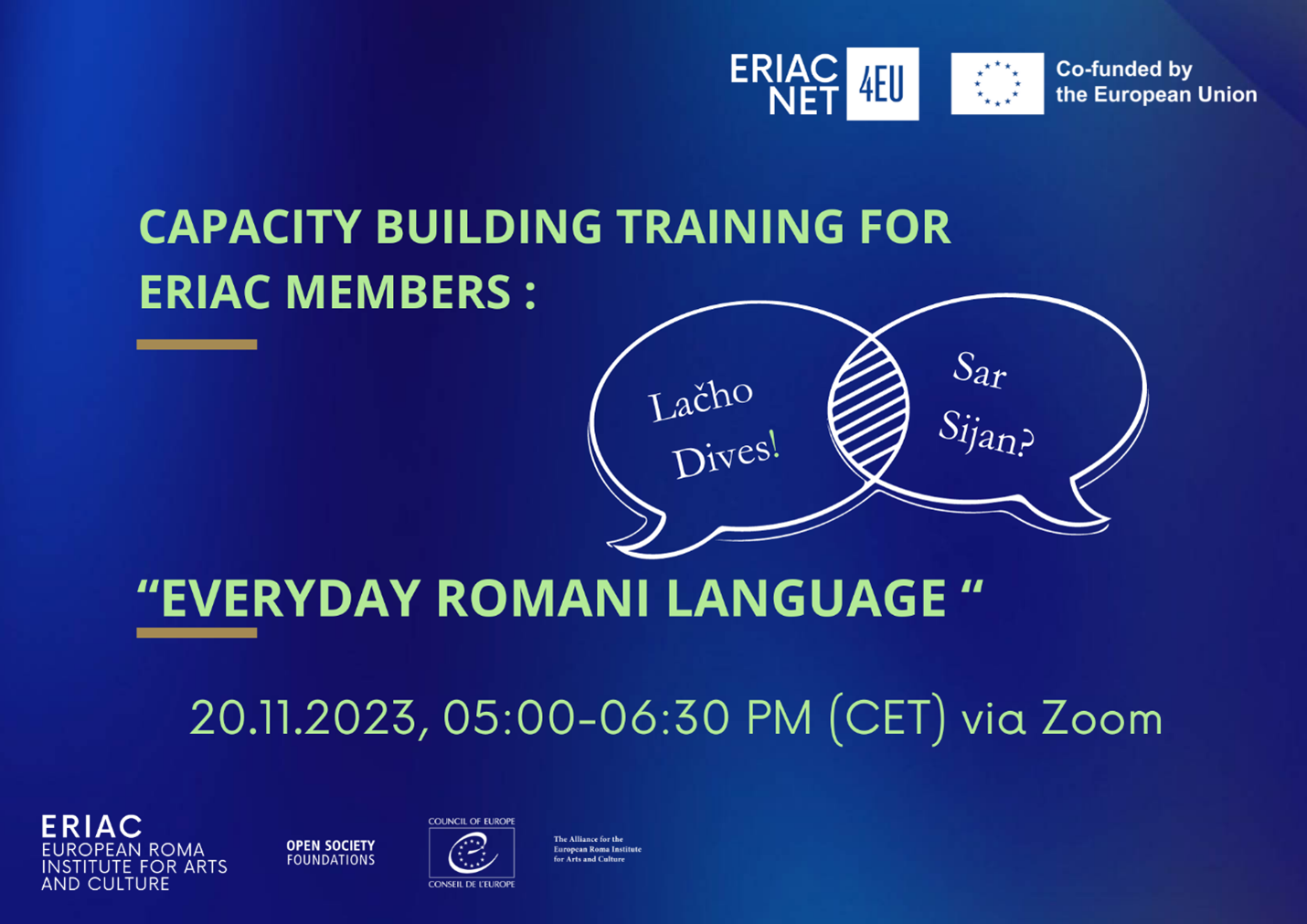
CAPACITY BUILDING TRAINING “EVERYDAY ROMANI LANGUAGE”
CAPACITY BUILDING TRAINING FOR ERIAC MEMBERS
“EVERYDAY ROMANI LANGUAGE”
Hosted by
European Roma Institute for Arts and Culture (ERIAC)
NOVEMBER 20, 2023
05.00-06.30 PM CET
Zoom link will be provided to registered participants.
Targeted Audience: In the frame of the ERIACNET4EU project, financed by the European Commission, ERIAC is offering a comprehensive training course exclusively for ERIAC members titled “EVERYDAY ROMANI LANGUAGE”. This training aims to provide ERIAC members with a profound understanding of the current status of the Roma language in Europe, while also introducing them to basic phrases in everyday Romanes and delving into arts and culture-specific terminology. This 90-minute virtual session is thoughtfully designed to equip ERIAC members with practical language skills and cultural insights that can be applied in daily life.
Targeted Audience: This training is tailored exclusively for ERIAC members, making it a unique opportunity for those interested in gaining insights into the Roma language and culture.
Date, Duration and Registration: To participate, please Register Here.
The training is scheduled for November 20, 2023, and will take place from 05:00 to 06:30 p.m. CET. A link will be provided upon registering. The training will be conducted via Zoom, ensuring a convenient and accessible virtual environment. Participants are encouraged to secure their spots by registering before Monday, November 13, 2023.
Expected Outcome: By the end of this training, participants can expect to gain a profound understanding of the Roma language’s current status in Europe, with insights into its significance and challenges. They will also acquire basic language skills in everyday Romanes, enabling them to communicate on a basic level. Additionally, participants will be introduced to arts and culture-specific terminology, allowing them to engage more deeply with the Roma culture and community.
Trainer: Mihaela ZATREANU, Romani language teaching expert.
Training will be held in English. You may learn more about the training agenda, trainer, and the event objective here.
The Everyday Romani Language Training is your gateway to mastering the Romani language for everyday interactions. We will bring the participants on an enriching journey, where everyday language opens doors to understanding and connection within the Roma communities.
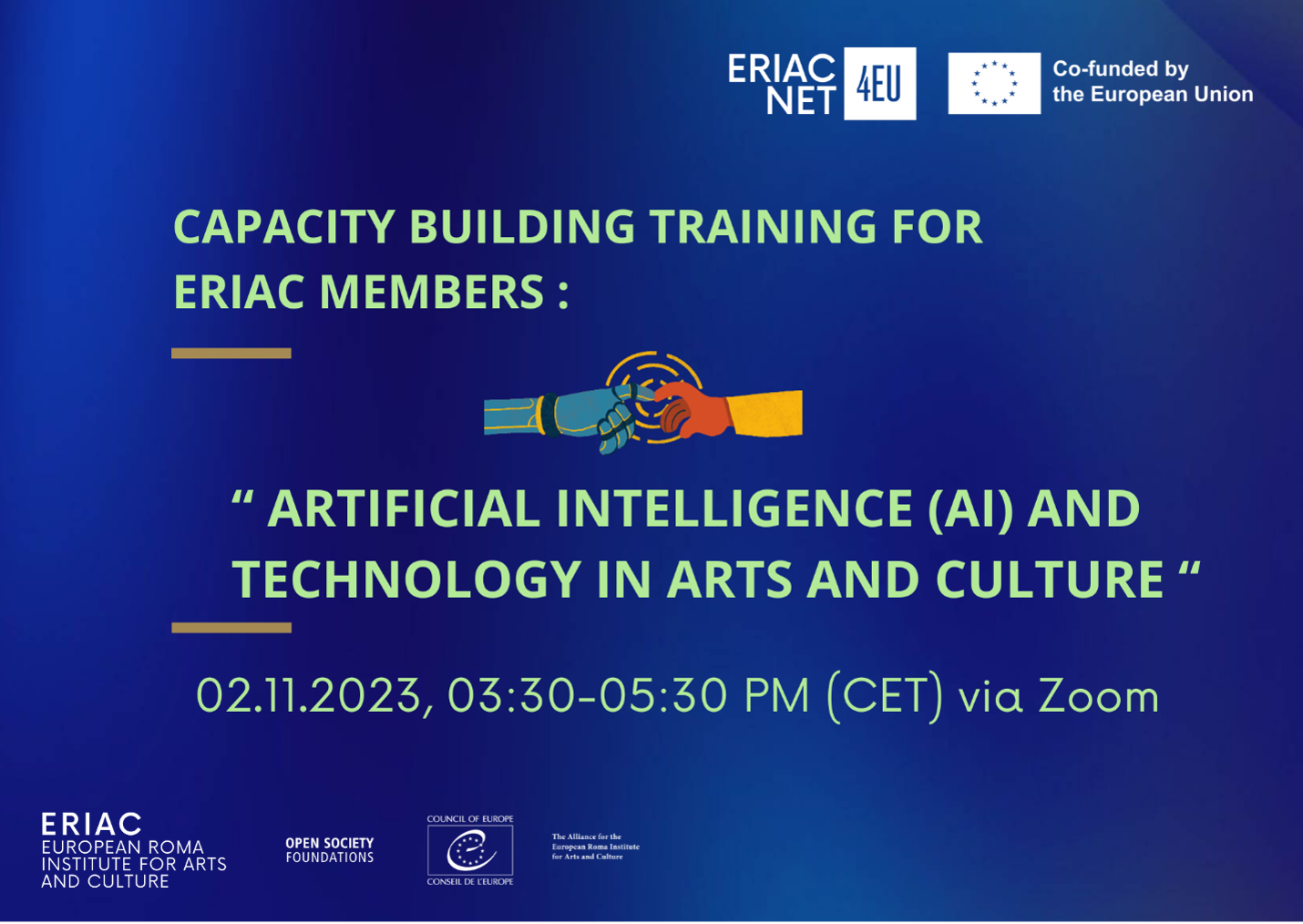
CAPACITY BUILDING TRAINING “ARTIFICIAL INTELLIGENCE (AI) AND TECHNOLOGY IN ARTS AND CULTURE“
CAPACITY BUILDING TRAINING FOR ERIAC MEMBERS
“ARTIFICIAL INTELLIGENCE (AI) AND TECHNOLOGY IN ARTS AND CULTURE”
Hosted by
European Roma Institute for Arts and Culture (ERIAC)
NOVEMBER 2, 2023
03.30-05.30 PM CET
Please register herelatest by Tuesday 31 October 2023
In the frame of ERIACNET4EU project, financed by the European Commission, ERIAC is offering a training course for ERIAC members titled “ARTIFICIAL INTELLIGENCE (AI) AND TECHNOLOGY IN ARTS AND CULTURE’’. This training will empower ERIAC members to explore the transformative potential of artificial intelligence (AI) and its applications in the realms of culture and the arts.
In an ever-evolving digital landscape, AI has become a force that shapes how we work and interact with technology. Therefore, understanding AI’s potential is crucial. This training aims to:
Introduce a range of AI tools, including ChatGPT, Midjourney and other, to enhance your creative and professional projects.
Deepen your understanding of AI’s core concepts and its potential impact on your work.
Address the ethical and philosophical dimensions of AI in the cultural and artistic domains.
Targeted Audience: This training is exclusively designed for ERIAC members, whether you are an artist, curator, cultural manager, or innovator. It offers valuable insights and skills to keep you at the forefront of your industry.
Date, Duration and Registration: The training is scheduled for November 2, 2023 and will take place from 03:30 to 05:30 pm CET. It will include interactive sessions, practical demonstrations, and opportunities for Q&A and discussion. The training will be conducted via Zoom. A link will be provided upon registering. To participate, please register via the following link by Tuesday, October 31, 2023: Registration Link
Expected Outcome: By the end of this training, you will have gained a deeper understanding of AI, practical skills in utilizing AI tools, and a heightened awareness of the ethical considerations in its implementation. You will be prepared to embrace AI as a catalyst for creativity, innovation, and the advancement of cultural and artistic endeavors.
Trainers: We are honored to have two distinguished trainers for this session:
Elizabete PALASIOSA: A digital transformation and creative industries expert with extensive experience in content development and program management.
Pauls SILIŅŠ: An accomplished digital literacy expert and a leader in advancing technology education for NGOs
Training will be held in English. You may learn more about the training agenda, trainers, and the event objective here.
Don’t miss this opportunity to delve into the world of AI and its potential in arts and culture.
PROJECT MANAGEMENT TRAINING FOR ERIAC RE-GRANTING BENEFICIARIES
#ERIACNET4EU
ERIAC is pleased to announce a significant milestone within the realm of the #ERIANCET4EU project: the Financial Management and Grant Administration Training. This specialized training has been meticulously crafted to cater exclusively to ERIAC member organizations that have demonstrated exceptional merit and have been honoured with grant awards. This initiative, made possible through the gracious support of the European Union’s Citizens, Equality, Rights, and Values Programme (CERV), underscores our unwavering dedication to advancing the interests of our esteemed member organizations.
Event Details: Date: September 4th, 2023 Time: 01:00 – 04:00 PM (CET) Platform: Virtual session via Zoom
For any queries you may have, please don’t hesitate to contact us at grants@eriac.org
The visionary project proposals of ERIAC members stand as a testament to their resolute commitment to uplifting their communities. The impending training session not only promises to enhance our collective expertise but also offers a platform for collaborative engagement with our esteemed grantees. We wholeheartedly encourage our grantees to foster collaboration not only among fellow grantees but to extend this collaboration to encompass ERIAC members who were not successful in their application endeavours. Stay tuned for further updates as we embark on this enriching journey together. Active participation and dedication of ERIAC members continue to drive the success of the #ERIANCET4EU project.
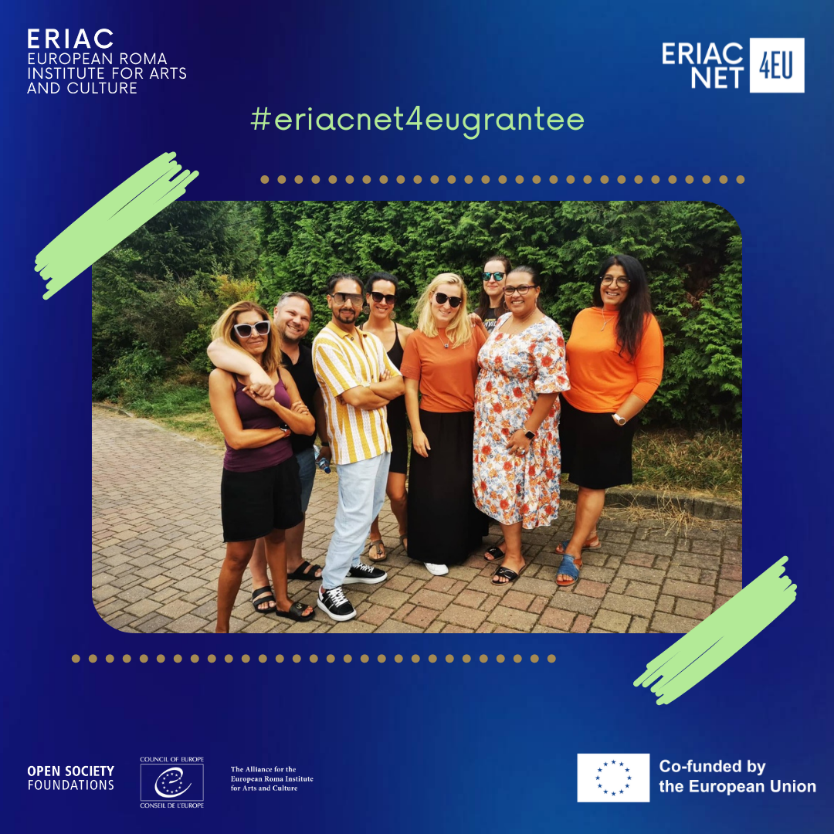
MEET OUR #ERIACNET4EU GRANTEES!
ERIAC is excited to officially announce the recipients of grants through the #ERIACNET4EU initiative. A significant amount of €170,000.00 has been allocated to support a total of 12 grants, thoughtfully given to ERIAC member organizations from 7 EU member states. This effort has been possible thanks to funding from the European Commission under the Citizens, Equality, Rights, and Values Programme (CERV).
In September, ERIAC will hold a comprehensive training session, designed to help the successful execution of these upcoming projects. We wholeheartedly encourage our grantees to foster collaboration not only among fellow grantees but to extend this collaboration to encompass ERIAC members who were not successful in their application endeavors. Keep an eye out for more information about #ERIACNET4EU.
We invite all forms of support that contribute to making bigger and more meaningful changes. If you’re interested in actively taking part in promoting a more inclusive Europe and tackling the harmful effects of anti-Roma racism, we warmly encourage you to consider making a pledge or donation through our organization. Also, we’re excited to welcome engagement to support our valued member organizations in different ways.
Your commitment and support play a crucial role in our shared journey toward a fairer and more harmonious society.
HARMONIZING HISTORY: SHOWCASING THE RICHES OF ROMANI CULTURE AND ARTISTRY IN EUROPE
Country/Location: Czech Republic
Grantee: Ara Art
Project title: Building Bridges Through Artivism
Implementation dates: October 2023 – June 2024 (9 months)
ERIACNET4EU grant offer: € 20,000.00
Project description:
The Ara Art organization, with the support of ERIAC and the European Union, will be actively executing the “Building Bridges Through Artivism” project. This initiative spotlights Romani history and art in Czech and European societies, aiming to foster awareness of shared European heritage, amplify Roma identity, and empower Romani artists’ leadership and civic engagement. At its core, the project commemorates significant Romani historical dates in the European context and advocates for equitable recognition of Roma contributions to the arts. Anticipated outcomes include a heightened appreciation of Romani heritage, increased Roma representation in cultural arenas, and policy reforms to support Romani culture. Ultimately, the initiative aims to bolster Romani pride, celebrate their culture, and boost public interest in showcasing Romani artists in mainstream spaces. Achieving these goals involves fostering dialogue between Roma and non-Roma communities, and fostering a deeper understanding of Romani culture across Czech and European societies.
AMPLIFYING ROMA VOICES: UNVEILING TRUTHS AND CULTIVATING INCLUSION IN EUROPE THROUGH INFORMED JOURNALISM
Country/Location: Czech Republic
Grantee: Romea
Project title: We give a voice to Roma
Implementation dates: October 2023 – September 2024 (12 months)
ERIACNET4EU grant offer: € 20,000.00
Project description:
The Romea organization with the support of ERIAC and the European Union, is spearheading the We give Roma a Voice project. This initiative aims to provide continuous, high-quality news coverage about the Roma community in the Czech Republic and Europe. By enhancing the Romea.cz news platform, the project seeks to expand readership through impactful reporting and engage young Romani journalists in a systematic exploration of various subjects. Together with external journalists, the Romea team will illuminate concealed information, dispel myths, and counter misinformation. This effort is crucial given the Roma community’s vulnerability to half-truths, particularly via social networks. Informed by accurate information, both Roma and non-Roma audiences can contribute to combating discrimination, making societal strides towards inclusivity.
NURTURING ROMANI POTENTIAL: EMPOWERING YOUTH AND WOMEN THROUGH THE ROMANI STRENGTH INITIATIVE
Country/Location: Hungary
Grantee: UCCU Roma Informal Educational Foundation
Project title: Activating Romani Strength
Implementation dates: September 2023 – September 2024 (12 months)
ERIACNET4EU grant offer: € 18,000.00
Project description:
The UCCU organization, with support from ERIAC and the European Union, is actively executing the Romani Strength project. This grant initiative is designed to facilitate and bolster the active participation of Romani youth and women within the public sphere, primarily through targeted awareness-raising campaigns. Moreover, the initiative seeks to fortify the network and collaborative interactions among civic society organizations and NGOs. The central focus of this project is to revitalize and enhance the Roma youth network, ultimately fostering a self-sustaining and self-organized collective wherein each member is empowered to initiate individual or group endeavors. UCCU’s paramount objective is to perpetuate a series of activities and workshops grounded in non-formal educational methodologies, effectively countering prevailing prejudices and stereotypes directed at the Roma community. Concurrently, the organization endeavors to orchestrate Roma cultural events and communication projects that serve the dual purpose of promoting Romani culture and engendering heightened awareness surrounding the multifaceted social and systemic challenges confronted by the Roma population.
CONVERGENCE OF CREATIVITY: UNITING ROMA AND NON-ROMA ARTISTS AT THE INTERNATIONAL SYMPOSIUM JAW DIKH!
Country/Location: Poland
Grantee: Jaw Dikh Foundation
Project title: International Symposium of Roma and Non-Roma Artists in Czarna Gora
Implementation dates: September 2023 – September 2024 (12 months)
ERIACNET4EU grant offer: € 16,000.00
Project description:
The Jaw Dikh organization, with support from ERIAC and the European Union, is set to host the annual International Symposium of Roma and non-Roma Artists. This gathering serves as an open-air art event, uniting artists from both Roma and non-Roma backgrounds whose creative pursuits are rooted in Roma culture. The symposium encompasses a diverse array of participants, ranging from painters, sculptors, and photographers to filmmakers, writers, and cultural commentators. Beyond fostering artistic creation, the symposium provides a dynamic platform for interdisciplinary discussions, facilitating the exchange of insights into the Roma community’s global context. Notably, it delves into the role of art in Roma political mobilization. Jaw Dikh! serves as a nexus for collaborative engagement, encouraging dialogue, and extending support among artists. As a burgeoning network of European Roma artists, it actively contributes to preserving traditions, affirming identity, and dispelling self-doubt. Central to its mission is the cultivation of a contemporary Roma identity—one that embraces diversity as a source of richness and collective strength, rather than an impediment. This inclusive approach transcends geographical boundaries, uniting Roma from various backgrounds in a shared pursuit of empowerment and cultural rejuvenation.
RESILIENCE ILLUMINATED: THE LEGACY OF RAYMOND GURÊME AND THE FIGHT AGAINST ANTIGYPSYISM
Country/Location: France
Grantee: National federation of associations working in solidarity with Roma and “Gens du voyage”
Project title: A story of struggle : a documentary about Raymond Gurême
Implementation dates: September 2023 – September 2024 (12 months)
ERIACNET4EU grant offer: € 15,000.00
Project description:
With the support of ERIAC and the European Union, the FNASAT organization is embarking on the “A Story of Struggle: The Raymond Gurême Documentary.” This project aims to research and chronicle the life of Raymond Gurême, a remarkable survivor of World War II internment camps and a prominent figure in the fight against antigypsyism. This research, article and short film will spotlight his experiences, including the often-overlooked nomadic internment in France from 1940 to 1946, shedding light on this lesser-known history. Inspired by Gurême’s courage and dedication, the film seeks to inspire new generations in the battle against antigypsyism. It serves a dual purpose: commemorating the Roma and Sinti persecution during WWII and addressing the contemporary challenge of antigypsyism. By amplifying the voices of young Roma and Sinti individuals, the short film underscores Gurême’s lasting impact on their commitment to combat discrimination. This short film will be accompanied by a reflective article to ensure accessibility to a wide European and international audience and serve to attract funds for developing a longer documentary in the future. Through this lens, “A Story of Struggle” will honor Raymond Gurême’s legacy while contributing to a vital dialogue on antigypsyism.
FLAMENCO HORIZONS: EXPLORING THE PATHWAYS OF CONTEMPORARY ARTISTRY
Country/Location: Spain
Grantee: National Association Gitano Presence & Cultural Association Flamenco World Heritage 21st Century (Asociacion Nacional Presencia Gitana & Asociación Cultural Flamenco Patrimonio de la Humanidad Siglo XXI)
Project title: Flamenco en el Siglo XXI / Flamenco in the 21st century
Implementation dates: September 2023 – February 2024 (6 months)
ERIACNET4EU grant offer: € 15,000.00
Project description:
With the support of ERIAC and the European Union, the Presencia Gitana/National Association Gitano Presence organization and the Cultural Association Flamenco World Heritage 21st Century are poised to host a comprehensive multi-day seminar focused on the contemporary landscape of Flamenco. This project will convene an international assembly of Flamenco stakeholders, encompassing artists, researchers, programmers, students, enthusiasts, experts, journalists, and decision-makers. The seminar aims to facilitate discourse, learning, and exchange on the diverse trajectories that Flamenco is currently navigating, as well as the challenges it confronts. The event, held in Madrid, the epicenter of Spanish artistic and cultural endeavors, will encompass presentations, debates, master classes, and concerts. By engaging firsthand perspectives, the seminar seeks to foster a comprehensive understanding and analysis of the present state of Flamenco art and its practitioners. The seminar aspires to engender an elevated awareness and heightened appreciation for Flamenco and its contemporary context. This, in turn, is anticipated to play a pivotal role in shaping the art form’s trajectory and future prospects.
Implementation dates: September 2023 – July 2024 (11 months)
ERIACNET4EU grant offer: € 15,000.00
Project description:
With support from ERIAC and the European Union, the Roma Actors Association (Giuvlipen) is launching the “Shakespeare in Romani Language Project.” This interdisciplinary initiative will adapt and produce a Shakespearean play entirely in Romani, collaborating with the Marin Sorescu National Theatre. The gender-focused adaptation will be showcased in Hungary and Italy, with partnerships from The Independent Theatre Hungary and Rampa Prenestina. The innovative production targets both Romani and non-Romani international audiences, enhancing intercultural dialogue and spotlighting the richness of Romani culture and linguistic heritage.”Shakespeare in the Romani Language” marks the first-ever translation, publication, and staging of Shakespeare’s dramaturgy in Romani. This pioneering project not only offers a unique cultural experience but also supports the preservation and revitalization of the Romani language, which is at risk of being lost. By presenting Shakespeare’s works in Romani, Giuvlipen aims to amplify the language’s artistic expression and cultural significance. The play will be published by Marin Sorescu Theatre and disseminated in Romani, Romanian, and English translations on the Roma Actors Association website.
Implementation dates: September 2023 – February 2024 (6 months)
ERIACNET4EU grant offer: € 15,000.00
Project description:
With support from ERIAC and the European Union, the Untold Stories Association is launching the “Roma Power Project” to address societal challenges faced by Roma women and promote Roma culture, rights, and acceptance. This multifaceted initiative includes producing a docudrama (“Roma Power”) highlighting a young Roma’s journey, organizing an event featuring the acclaimed film “Gipsy Queen” and the docudrama premiere, hosting storytelling workshops for Roma youth led by Alina Serban, and offering online screenings of films like “Letter of Forgiveness,” “I Matter,” and “I am Nicu” that explore Roma experiences. This project seeks to combat discrimination, foster understanding, and encourage diversity and tolerance. By empowering young Roma women through workshops and showcasing Roma stories in cultural spaces, including a live Q&A session with Alina Serban and the Romanian Cultural Institute, it aims to amplify the voices of Roma women and address multiple forms of discrimination they face. Additionally, the project aims to elevate awareness of Roma culture and promote acceptance, especially among the younger generation.
RECLAIMING ROMA NARRATIVES: ART UNVEILING IDENTITY
Country/Location: Spain
Grantee: Rromane Siklovne, Association of Young Roma Students of Bon Pastor
Project title: Romani Identity Through Art
Implementation dates: September 2023 – August 2024 (12 months)
ERIACNET4EU grant offer: € 12,000.00
Project description:
With support from ERIAC and the European Union, Rromane Siklovne launches the Romani Identity Through Art project. This initiative, aided by an exhibition, aims to reshape narratives surrounding Roma existence and self-expression, countering negative stereotypes and fostering dialogue. By analyzing works from diverse Roma authors across artistic domains, the project distills key messages for a transnational Roma identity. The resulting exhibition in Barcelona will share Roma values and perspectives, countering historical anti-Roma narratives. This effort aims to present a comprehensive Roma narrative, highlighting cultural richness and self-representation beyond prevailing societal definitions that have led to persecution. Through literature and music, this project offers an encompassing Roma worldview, promoting a redefined understanding of Roma existence.
FASHIONING DIVERSITY: ELEVATING ROMA DESIGNERS IN EUROPE
Country/Location: Belgium
Grantee: REDI INTERNATIONAL ASBL
Project title: Fashioning Inclusion: Empowering Roma Designers through the Roma Business Club and Fashion Exhibition
Implementation dates: September 2023 – August 2024 (12 months)
ERIACNET4EU grant offer: € 10,000.00
Project description:
With the support of ERIAC and the European Union, REDI initiates the “Fashioning Inclusion: Empowering Roma Designers” project. This effort establishes the pioneering Roma Fashion Business Club, aimed at nurturing Roma designers from Romania, Bulgaria, Italy, and Spain. By means of workshops, mentorship, and networking, the club nurtures entrepreneurial talent and fosters collaboration. Simultaneously, a Brussels-based fashion exhibition will spotlight Roma designers, challenging stereotypes and promoting inclusivity. The project addresses the underrepresentation of Roma designers, defying stereotypes through the Roma Business Club and an exhibition. Through resources, networking, and skill enhancement, the project bolsters Roma entrepreneurs and sparks collaboration, elevating their presence within the industry. The outcomes encompass heightened visibility, recognition, and a shift in perceptions. This endeavor envisions fostering pride, inclusivity, and economic prospects for Roma designers. The project, executed in partnership with designers from Romania, Bulgaria, Italy, and Spain, features the inclusive Roma Business Club. The fashion exhibition, situated in Brussels, spotlights Roma creativity.
Implementation dates: September 2023 – May 2024 (8 months)
ERIACNET4EU grant offer: € 8,000.00
Project description:
With support from ERIAC and the European Union, Rromane Collective Arts and Culture introduces the Loly Haute Couture project. This transformative journey blends Roma heritage and contemporary design, resulting in 8 exclusive outfits that intricately weave traditional symbols into modern fabrics. This initiative breaks new ground for the Loly brand, expanding beyond “pret-a-porter” fashion. By celebrating Roma culture and identity, we address past misrepresentations and elevate our presence in the fashion industry. The collection showcases 8 outfits that embody Roma values, featuring reinterpretations of the Roma wheel, floral motifs, and musical instruments. These unique creations will grace exhibitions, fashion shows, and the 2024 Cultural Style Week in London. The Haute Couture Loly project is driven by a contemporary Roma spirit, celebrating both culture and the craftsmanship of Roma artists. This bold fusion challenges norms and propels Roma heritage into the forefront of high fashion, fostering wider recognition and appreciation.
CELEBRATING ROMANI HERITAGE: ELEVATING AWARENESS BY BRINGING THE ROMA VIRTUAL MUSEUM CLOSER TO YOU
Country/Location: Romania/ International (online access)
Grantee: Association Roma Center Amare Rromentza
Project title: Amaro Museo – Amaro Ceacipe – Rroma Virtual Museum Promotion
Implementation dates: September 2023 – August 2024 (12 months)
ERIACNET4EU grant offer: € 6,000.00
Project description:
The Association Roma Center Amare Rromentza, in collaboration with support from ERIAC and the European Union, is advancing the “Rroma Virtual Museum Promotion” initiative. This project aims to amplify the visibility of the Roma virtual museum—a unique platform celebrating Romani history and culture. Its mission is to enhance awareness of Roma arts and culture among diverse communities, shedding light on their significant contributions to Romanian and European heritage. The project counters anti-Roma biases through active cultural promotion, fostering positive perceptions of the Roma community.
The Roma (commonly referred to as “Gypsies” which is an ethnic slur) have been part of the European and national histories and cultural landscapes for over 700 years. Today, the Roma constitute the biggest ethnic minority in Europe with some 10 million citizens in the EU and a global diaspora of over 15 million people. Yet, despite their centuries-old presence, the Roma remain largely unknown to majority societies. As a people, the Roma are mostly thought of and treated as a social problem, perceived through the prism of marginalization, exclusion and poverty. Moreover, the Roma today are the most stigmatized and the least accepted minority group in the EU; diverse manifestations of antigypsyism – the specific form of racism against the Roma people – are a regrettable feature of the daily lives of Roma in Europe. On the other hand, however, the Roma remains a highly resilient and creative population whose diverse contributions to European social, cultural, economic, political, artistic, and even linguistic fields are yet to be acknowledged and embraced.
In the frame of ERIACNET4EU project, ERIAC is offering a trainingcourse on Romani culture and history entitled “ROMA(NI) PAST – EUROPE’S FUTURE. WHY EMBRACING EU’S LARGEST ETHNIC MINORITY MATTERS”. This training course will provide a brief overview of Romani history and culture as a point of departure to reflect on the social, political, cultural, economic and environmental importance of positioning Roma at the core of EU’s public debates regarding our societal futures. The training, organized in connection to the Timisoara European Capital of Culture 2023, is specifically tailored for members of staff of public administration and of the European Union Institutions. The course will explore the difficult, sensitive or contentious issues related to Roma and antigypsyism, and help identify and incorporate human rights concerns into the work of public officials. This year, the training will specifically target Romanian public authorities by hosting a specific session dedicated to the history and culture of Roma in Romania. Speakers of other sessions will be invited to incorporate specific examples which illustrate the Romanian context. To enable participation, the training will provide simultaneous Romanian-English translation.
The course will be delivered by a group of experienced Romani scholars, with relevant expertise in the field, including knowledge of the most recent discussions in Romani Studies as well as most recent Roma-related EU and Romanian developments. The training is divided into the following thematic segments:
“Introduction to Romani history and identity” by Dr. Adrian Marsch
“Roma culture – Europe’s heritage” by Dr. Rosemary Cisneros
“Antigypsyism in theory and practice – unpacking different dimensions of racism against Roma communities” by Dr. Iulius Rostas
“From Roma Resistance to Roma Agency” by Dr. Anna Mirga-Kruszelnicka
“Roma in Romania – from slavery to emancipation” by Dr. Ioan Valentin Negoi and Adela Bobu
Language of training: English and Romanian (simultaneous translation will be provided).
Training will be held in a hybrid format, physically at the West University in Timisoara, and online. Participation is open and free of charge.
Romii (numiți în mod obișnuit ț*****, ceea ce reprezintă o insultă etnică) fac parte din istoria și peisajul cultural european și național de peste 700 de ani. În prezent, romii constituie cea mai mare minoritate etnică din Europa, cu aproximativ 10 milioane de cetățeni în UE și o diasporă globală de peste 15 milioane de persoane. Cu toate acestea, în ciuda prezenței lor vechi de secole, romii rămân în mare parte necunoscuți de societățile majoritare. Ca popor, romii sunt în general considerați și tratați ca o problemă socială, percepută prin prisma marginalizării, a excluderii și a sărăciei. Mai mult, romii sunt astăzi cel mai stigmatizat și cel mai puțin acceptat grup minoritar din UE; diversele manifestări de antigypsism – forma specifică de rasism împotriva romilor – sunt o caracteristică regretabilă a vieții de zi cu zi a romilor din Europa. Pe de altă parte, romii rămân totuși o populație extrem de rezistentă și creativă, ale cărei contribuții diverse la domeniile sociale, culturale, economice, politice, artistice și chiar lingvistice europene nu au fost încă recunoscute.
În cadrul proiectului ERIACNET4EU, ERIAC oferă un curs de formare privind cultura și istoria romilor, intitulat “TRECUTUL ROMILOR – VIITORUL EUROPEI. DE CE ESTE IMPORTANT SĂ NE APROPIEM DE CEA MAI MARE MINORITATE ETNICĂ DIN UE“. Acest training va oferi o scurtă prezentare generală a istoriei și culturii romilor, ca punct de plecare pentru a reflecta asupra importanței sociale, politice, culturale, economice și de mediu a poziționării romilor în centrul dezbaterilor publice din UE privind viitorul societății noastre. Formarea, organizată în legătură cu Timișoara Capitală Europeană a Culturii 2023, este special concepută pentru membrii personalului din administrația publică și din instituțiile Uniunii Europene. Trainingul va explora aspectele dificile, sensibile sau controversate legate de romi și de antigypsism și va contribui la identificarea și încorporarea preocupărilor legate de drepturile omului în activitatea funcționarilor publici. În acest an, trainingul se va adresa în mod special autorităților publice din România, găzduind o sesiune specifică dedicată istoriei și culturii romilor din România. Vorbitorii celorlalte sesiuni vor fi invitați să includă exemple specifice care să ilustreze contextul românesc. Pentru a încuraja participarea, cursul de formare va oferi traducere simultană română-engleză.
Cursul va fi ținut de un grup de cercetători romi cu experiență, cu o expertiză relevantă în domeniu, inclusiv cunoștințe despre cele mai recente discuții din domeniul studiilor romilor, precum și despre cele mai recente evoluții din UE și din România legate de romi. Cursul este împărțit în următoarele segmente tematice:
“Introducere în istoria și identitatea romilor” de Dr. Adrian Marsch
“Cultura romă – moștenirea Europei” de Dr. Rosemary Cisneros
“Antigypsism în teorie și practică – prezentarea diferitelor dimensiuni ale rasismului împotriva comunităților rome” de Dr. Iulius rostas
“De la rezistența romilor la agenția romilor” de Dr. anna Mirga-Kruszelnicka
“Romii din România – de la sclavie la emancipare” de Dr. Ioan Valentin Negoi și Adela Bobu
Limba de desfășurare a cursului: Engleză și română (se va asigura traducere simultană). Cursul se va desfășura într-un format hibrid, fizic la Universitatea de Vest din Timișoara și online. Participarea este deschisă și gratuită.
Evenimentul face parte din proiectul ERIACNET4EU – ERIAC Network pentru promovarea incluziunii romilor prin combaterea și prevenirea antigypsism-ului în UE.
The event is part of the project ERIACNET4EU – ERIAC Network to Advance Roma Inclusion by Combatting and Preventing Antigypsyism in the EU.
CALL FOR APPLICATIONS | ERIACNET4EU GRANT: Protect and Promote EU Values and Rights
Application Deadline: June 17, 2023
In the frame of the ERIANCET4EU project financed by the Citizens, Equality, Rights and Values Programme (CERV) of the European Union, and with a long-term goal of using culture and cultural diplomacy to strengthen open, rights-based, democratic, equal and inclusive society in EU, the European Roma Institute for Arts and Culture (ERIAC) is inviting applications from its member organizations based in the EUthat seek to change narratives about Roma in Europe through advocacy, cultural diplomacy and intercultural exchange between Roma and non-Roma.
General objective of the call is to strengthen capacity to protect and promote EU rights and values and increase citizen awareness of EU rights and values. We are looking for projects with a clear European dimension that:
strengthen capacity to protect and promote EU rights and values and increase citizen awareness of EU rights and values
contribute to the fight and prevention of antigypsyism, by employing counter-narratives through arts, culture, history, education and the media and a higher degree of Roma participation and self-representation,
advocate for Roma cultural inclusion and a holistic and preventive approach to fighting antigypsyism and in doing so contribute to policy-making processes affecting the Roma,
strengthen the organisations and leaders in the Roma movement through networking and collaboration between Roma and non-Roma led civil society organisations,
challenge dominant, harmful narratives about Roma and present alternate narratives that incorporate culture and Romani contribution to the EU and seek to broaden the base of supportive allies.
GRANT STRUCTURE
The grants will be awarded for a minimum of 2 months and a maximum ofone-year period projects through the following tranches:
Small Scale Projects in between 5.000 – 10.000 EUR;
Medium Scale Projects of 15.000 EUR;
Large Scale Projects of 20.000 EUR;
How to apply?
Proposal can be submitted between April 7, 2023 – June 17, 2023. Applications received later will not be considered.
Applicants are required to submit an application in English via the online application form.
In case of questions, please reach out to ERIAC via eriac@eriac.org writing in the Subject Line: ERIAC Grant
PERIPHERIES UNITE! PUBLIC DEBATE
Peripheries Unite! With the occasion of 16 MAY – Day of Romani Resistance, we have opened a public discussion on cultural resistance, social justice and the potential of alliances across movements in Europe.
In the frame of ERIACNET4EUproject, the European Roma Institute for Arts and Culture (ERIAC) brought together the experts Emilia Roig (author and scholar), Director of the Center for Intersectional Justice, Tayo Awosusi-Onutor (singer/activist), Board of Directors of RomaniPhen, and Anna Mirga (author/activist), Deputy director of ERIAC, for “Peripheries Unite!” – a transdisciplinary discussion on the potential of building bridges across movements to advance with the common struggle of building a fair, peaceful and more inclusive Europe for all.
Today, millions of Europeans experience multiple discrimination due to intersecting dimensions of identity, including race, ethnicity, sexual identity and orientation, religion, class, nationality and citizen status, among others. Prevalent discrimination – including specific types of racism such as antigypsyism or Afrophobia, as well as islamophobia, homophobia and sexism– push European citizens to the margins of society by seriously impeding their access to equal rights and opportunities.
Roma – the biggest ethnic minority in the EU – are among the most discriminated against groups. Likewise, Europeans of African descent, Jews, Muslims and persons belonging to the LGBTIQ community face widespread discrimination. Each of these populations has been forging civic movements of their own to fight for equality and social justice. In this process, they have employed diverse strategies of resisting oppression, building political power and empowering their communities.
The public debate hosted by ERIAC will provide an opportunity to exchange experiences between different minority groups, pointing to striking similarities between communities and their struggles. Such discussion is both necessary and timely. As the agency of those belonging to minority groups grows, they claim their rightful place at the centre of social, political and economic affairs on national and international levels.
ERIAC provides a platform for Roma and representatives of other minority groups in Europe to reflect together on strategies for building solidarity and closer collaboration across diverse social movements, united around the same values of social justice, inclusivity and respect.
The event is part of the public discussion series „Promoting European Values Through Cultural Heritage” of ERIACNET4EU – ERIAC Network to Advance Roma Inclusion by Combatting and Preventing Antigypsyism in the EU.
BRINGING THE EU CLOSE TO ROMA – WEAVING ROMA CULTURE INTO THE FABRIC OF SUSTAINABLE DEVELOPMENT
Date: April 22, 2023
Topic: Public discussion on sustainable development
Location: Timisoara, Romania (hybrid event) Time: 15.00 – 17.00 (CET)
In the frame of the Citizens, Equality, Rights and Values Programme (CERV) of the European Union, ERIAC is leading the initiative ERIACNET4EU! With the adoption of the new EU Roma Framework, the EU and its member states move towards implementation where expert advice, as well as reliable partners on all levels of policy-making and implementation (local, regional, national, European), are needed. ERIAC and its wide and distinguished membership together with an alliance of donors- and partner organizations feed expertise, specific know-how, and reliable methodologies to support the implementation of the new framework.
The radicality, progressive and professional quality of this initiative lies within the responsibility and leadership Roma took for providing informed, reliable, consolidated, and quality input to European and national policy-makers and public institutions, to increase the effective implementation of strategies and laws that affect the lives of Roma in the EU!
In the month of April 2023, ERIAC prepared a line of high-quality public events to celebrate Roma pride, self-determination and contribution to European and national histories and cultures.
For this event – in the frame of the ᴛɪᴍɪꜱᴏᴀʀᴀ ᴄᴀᴘɪᴛᴀʟ ᴏꜰ ᴄᴜʟᴛᴜʀᴇ – the European Roma Institute for Arts and Culture (ERIAC, www.eriac.org) brings together Roma and non-Roma experts and policymakers for a forward-looking transdisciplinary discussion on the role of culture in achieving sustainable development in Europe.
Our speakers: Alexandru Fechete (Radio Pata), Lestat Monroe (Romanian Diversity Chamber of Commerce), Istvan Szakats (Radio Pata), Jasmina Usainovic (Roma Entrepreneurship Development Initiative), Alexandru Zemfir (Roma Education Fund). Moderated by Timea Junghaus (ERIAC)
The European Roma Institute for Arts and Culture e.V. (ERIAC) is a joint initiative of the Council of Europe, the Open Society Foundations, and the Roma Leaders’ initiative – the Alliance for the European Roma Institute for Arts and Culture.
ERIAC THEMATIC SECTION DISCUSSIONS
Dates: 23 & 24 March 2023
Topic: Membership Online Meetings on the role of community, collective celebration of Roma people’s labor, creativity, and intellect.
At ERIAC, we truly believe that the ERIAC membership community is our source of strength and pride. In
2023, ERIAC is inviting the entire ERIAC membership community to come closer together by providing a
safe space for critical reflection, brainstorming and cooperation.
The meetings were held with the support of the ERIAC Board and Barvalipe Academy members, the ERIAC thematic section coordinators and the ERIAC management.
CALENDAR THEMATIC SECTION DISCUSSIONS 2023:
1. Arts and Culture
March 23, 2023 // 12:30 – 2:00 PM CET 2. Knowledge Production
March 23, 2023 // 2:00 PM – 3:30 PM CET 3. History and Commemoration
March 23, 2023 // 3:30 – 5:00 PM CET 4. Media and Information
March 24, 2023 // 2:00 – 3:30 PM CET 5. Romani Language
March 24, 2023 // 3:30 – 5:00 PM CET
ABOUT THE ERIAC MEMBERSHIP DISCUSSION MEETINGS
ERIAC membership is our source of strength and pride. ERIAC membership is also a resource: activating
knowledge and expertise, ideas and recommendations, network and connections of individual and
institutional members for collective purpose on the field of Roma arts and culture. It is for this reason
that in 2023 ERIAC is inviting the entire ERIAC membership community to come closer together by
providing a safe space for critical reflection, brainstorming and cooperation.
Objectives:
Provide a space for ERIAC Associate Members to become familiar with ERIAC Project Activities
Sharing the results from the ERIAC Survey – V. General Assembly follow up
Develop thematic priorities for each section
ERIAC Call for Members 2023
Information on ERIAC’s Launch Call for Grants 2023
Build shared understanding on ERIAC’s 2023 Collaborations
Develop a collective purpose on the field of Roma arts and culture
Facilitate the involvement of members in ERIAC programming
The ERIAC membership meeting series will be developed through a cooperation between ERIAC
statutory organs, ERIAC management and ERIAC section facilitators.
ERIACNET4EU 2022 Higlights
V. GENERAL ASSEMBLY
Date: December 8-9, 2022 Location: Berlin (hybrid event) Topic: V. General Assembly Meeting of ERIAC Members and Annual Networking Event
On December 8-9, 2022, the European Roma Institute for Arts and Culture (ERIAC) held its V General Assembly meeting, which took place in a hybrid form – physically in ERIAC Office, Berlin and online via ZOOM. For this meeting, all ERIAC statutory bodies, including ERIAC Board members, ERIAC Barvalipe Academy members, ERIAC associate members, and the ERIAC staff came together. for the nourishing ritual of reflection and hatching new plans. The meeting was envisioned as a two-day-long respite, a dwelling where our community could flourish and collectively celebrate Roma people’s labor, creativity, and intellect.
On December 9, we closed the Assembly with a vernissage of the exhibition Woman to Woman showcasing works of Małgorzata Mirga-Tas and Eugen Raportoru. Presenting the works of artists who stole the hearts of art connoisseurs from all over the world at the 59th International Art Exhibition La Biennale di Venezia, was the best way to close what we started to call the Golden Year of Romani Arts. The in-person attendees were also able to enjoy the party with live music featuring The Pillers, Gipsy Groove and Dj Nomi.
ROMA(NI) PAST – EUROPE’S FUTURE. WHY EMBRACING EU’S LARGEST ETHNIC MINORITY MATTERS
Date: October 14, 2022 Time: 10.00 – 17.00 (CET), ZOOM Topic: Online course on Romani culture
Roma have been part of the European and national histories and cultural landscapes for at least 700 years. Today, Roma constitute the largest ethnic minority in Europe with some 10 million citizens, and a global diaspora of over 15 million people. Yet despite the centuries-old presence, Roma remain largely unknown to majority societies. As a people, Roma are mostly thought of and treated as a social problem, perceived through the prism of marginalization, exclusion and poverty. Moreover, Roma today are the most stigmatized and discriminated minority in the EU; diverse manifestations of antigypsyism – the specific form of racism against Roma people – are a regrettable feature of daily lives of Roma in Europe. On the other hand, however, Roma remain a highly resilient and creative population whose diverse contributions to European social, cultural, economic, political, artistic, and even linguistic fields are yet to be acknowledged and embraced.
This online course provided a brief overview of Roma history and culture as a point of departure to reflect on the social, political, cultural, economic and environmental importance of positioning Roma at the core of EU’s public debates regarding our societal futures. The course explored the difficult, sensitive or contentious issues related to Roma and antigypsyism, and help identify and incorporate human rights concerns into the work of public officers at local, regional, national or EU level.
Trainers: Zeljko Jovanovic, Timea Junghaus, Dr Adrian R. Marsh, Isabela Mihalache, Dr Anna Mirga-Kruszelnicka, Dr Iulius Rostas. Moderator: Dr Ioaninda Costache.
Topic: Bringing the EU close to Roma – information session on the role of the EU in Roma inclusion efforts, outlining opportunities for participation and funding
possibilities
ERIACNET4EU network project aims at protecting, promoting and raising awareness of rights of Roma citizens of the EU and thereby at strengthening the EU values, in particular of equality, justice and non-discrimination and thus contributing to building a more democratic EU where all citizens can enjoy equal access and protection of their rights. The ERIACNET4EU project will offer expertise, specific know-how and reliable methodologies to support the implementation of the new EU Romaframework.
Speakers: Violeta Naydenova (Open Society Foundations), Ciprian Necula (Roma Education Fund), Rosa Cisneros (Weave), Petrica Dulgheru (Roma Entrepreneurship Development), Isabela Mihalache (ERGO), Iulius Rostas (Expert on EU policy), Neda Korunovska (Open Society Foundations RIO)
15:30 Introduction by ERIAC on the background and the purpose of the meeting
Welcome remarks by Gilda Horvath, ERIAC Board
Why are we having an ERIACWOMNET meeting?
What do we understand under female leadership?
Why is female leadership important to us?
15:40 Short overview on statistics of women % (visualized) in ERIAC membership by Timea Junghaus
15:50 Inspirations of ERIAC female leaders/ shortly
Ethel Brooks
Lavinia Banu
16:15 Opportunities for ERIAC women members
How to be involved?
How to attract more women to become members?
How to contribute?
How to empower each other?
How to support?
16:50 Conclusions and next steps
PROJECT LAUNCH
ONLINE EVENT
Date: February 28, 2022 Time: 15:00 – 16:40 CET
As part of the Citizens, Equality, Rights and Values Programme (CERV) of the European Union, ERIAC is launching a new project: ERIACNET4EU: ERIAC NETWORK TO ADVANCE ROMA INCLUSION BY COMBATTING AND PREVENTING ANTIGYPSYISM IN THE EU.
The project aims at protecting, promoting and raising awareness of rights of Roma citizens of the EU and thereby at strengthening the EU values, in particular of equality, justice and non-discrimination and thus contributing to building a more democratic EU where all citizens can enjoy equal access and protection of their rights. ERIACNET4EU will offer the expertise, specific know-how and reliable methodologies to support the implementation of the new EU Roma framework by focusing on strategies and methodologies to prevent and combat antigypsyism.
On February 28 2022, at 15:00 CET, we are hosting an online public launching event of the project, envisaged as a space for reflection on confronting antigypsyism for a peaceful and sustainable Europe.
Funded by the European Union. Views and opinions expressed are however those of the author(s) only and do not necessarily reflect those of the European Union or European Education and Culture Executive Agency (EACEA). Neither the European Union nor the granting authority can be held responsible for them.